

140 Series for Admission Calls: TRAI Rules for Institutes

The 140 series is the number range TRAI reserves for promotional voice calls in India. Admission calls that market a course to a prospective student are promotional, so they belong on a registered 140-series number, not on an ordinary mobile.
That one sentence unsettles a lot of admission offices, because the usual set-up is a room of counsellors dialling from personal or company SIMs. This guide explains what the 140 series means for colleges, universities, coaching institutes and edtech companies: which of your calls count as promotional, why the 1600 series is closed to most of you, how Do Not Disturb preferences apply to education, and what to change before the next admission season.
Why are institutes looking at the 140 series now?
The framework is not new. The Telecom Commercial Communications Customer Preference Regulations date from 2018. Two recent events moved it up the agenda for education.
On 12 February 2025 the Telecom Regulatory Authority of India issued the Second Amendment to those regulations. It barred the use of ordinary 10-digit numbers for telemarketing, shortened the time operators have to act on complaints, and lowered the number of complaints needed to trigger action.
Then, in July 2026, TRAI published a clarification on the two designated series. It restated that the 1600 series is for service and transactional calls by financial entities regulated by the RBI, SEBI, IRDAI and PFRDA and for government communication, and that the 140 series is for promotional calls by entities in any sector. Education sits in "any sector".
The scale. According to TRAI data reported by The Economic Times, about 13.16 billion promotional calls originated on the 140 series between April and June 2026. Around 1.48 billion were blocked after preference checks, close to 11 percent.
Is an admission call promotional or a service call?
The answer depends on who you are calling and what the call is for, not on which department makes it. The table sorts the calls an admission office typically makes. It reflects our reading of the regulations; your access provider has the final say on how your traffic is registered.
| Call | Likely category | What it needs |
|---|---|---|
| First call to a list from a school fair, portal or data partner | Promotional | 140-series number, and a check against the student's preferences or their explicit consent |
| Callback to a student who submitted your enquiry form | Promotional in content, made on the strength of their request | 140-series number. Record consent on the form, because consent given to complete a transaction is time-limited |
| Follow-ups weeks later to a student who has not applied | Promotional | 140-series number and a durable, recorded consent, or a preference check |
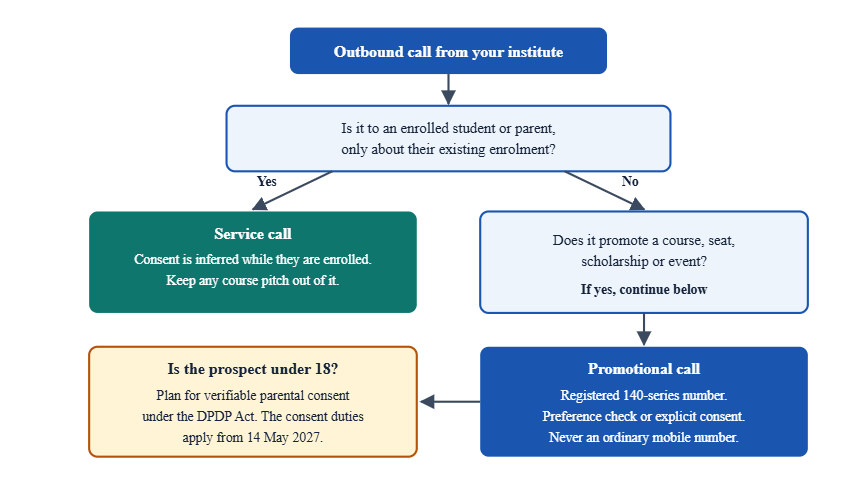
| Fee reminder or exam schedule to an enrolled student | Service | Inferred consent lasts for the length of the enrolment. Ask your operator which registered number applies |
| Fee reminder that also pitches a new course | Promotional | Mixing a pitch into a service call makes the whole call promotional |
| Offer of a second course to a current student | Promotional | Enrolment in one programme is not consent to be sold another |
The decision is easier to hold as a short flow.
Can a college or coaching institute use a 1600-series number?
In most cases, no. Parents trust 1600 numbers because banks and insurers call from them, so the question comes up often. TRAI's clarification is specific about who qualifies: financial entities regulated by the RBI, SEBI, IRDAI and PFRDA, calling their existing customers, and government bodies communicating with citizens. A private university, a coaching chain and an edtech company are none of these.
This holds even for calls that feel official, such as confirming an admission or a counselling slot. The category of the call does not change who is eligible for the series. Government institutions should ask their access provider whether their communication qualifies under the government route.
There is a useful side to the same clarification. Calls from the 140 series are not to be tagged or filtered by operators, other than blocking that follows from a subscriber's own preferences. A properly registered admission call should not be labelled as spam by the network simply for being promotional.
What did the February 2025 amendment change?
Six changes affect an admission calling team directly.
- Ordinary numbers are out. Senders may not use normal 10-digit numbers for telemarketing. Promotional calling is meant to run on the 140 series.
- Complaints are easier to make. A subscriber can report an unwanted call within seven days, up from three, and no longer has to be registered on the preference list first.
- Operators must respond faster. Access providers have five days to act on a complaint against an unregistered sender. The earlier limit was thirty.
- The trigger is lower. Five complaints against a sender within ten days is now enough for action. Before, it took ten complaints in seven days.
- Consent has limits. Inferred consent holds only while a contractual relationship lasts. Consent given to complete an ongoing transaction is valid for seven days. After someone opts out, you may not ask them for consent again for ninety days.
- Automated calling must be declared. The amendment expects senders to tell their access provider before running auto-dialer or pre-recorded call campaigns. Confirm the process with your operator.
The consequence that matters to an institute is losing its telephone resources. TRAI's press note describes outgoing services being barred for a first violation and, for repeat violations, disconnection across all access providers for up to a year along with blacklisting. For an admission office, that could mean no outbound calling in the middle of the season.
For the cross-sector background, see Elision's complete guide to the 140 and 160 series.
How does the Education preference in DND affect your campaigns?
The preference register lets a subscriber block all promotional communication or allow it by category. Education is one of those categories, alongside banking, real estate, health, consumer goods and others. TRAI's 2026 clarification confirms that a subscriber who has blocked a sector will not receive 140-series calls from entities in that sector.
Three practical points follow.
- Scrub before you dial. A list bought at a fair in March can contain many numbers whose owners have blocked education calls. Checking preferences before a campaign protects counsellor time as well as compliance.
- Explicit consent travels further. Where a student has given explicit consent to your institute through a recognised digital process, the regulations allow that consent to override their general block. A tick-box buried in terms and conditions is weak evidence. A clear statement on the enquiry form, stored with a timestamp, is much stronger.
- Opt-outs are final for a while. When a parent says "do not call again", mark the number immediately. The ninety-day bar on asking again starts there.
What about prospects who are under 18?
This is where education differs from almost every other sector that uses the 140 series. A bank's prospects are adults. Many of yours are 16 or 17.
The Digital Personal Data Protection Act, 2023 classes anyone under 18 as a child and requires verifiable consent from a parent or guardian before that child's personal data is processed. A phone number, a name and a course interest are personal data. The Digital Personal Data Protection Rules were notified on 14 November 2025, and the obligations on verifiable consent for children apply from 14 May 2027. Penalties for breaching the children's data provisions can reach ₹200 crore.
Educational institutions do receive limited relief under the Rules, but it is tied to educational activities and the safety of children enrolled with them. A marketing call to a Class 12 student who has only filled in a form is a different activity. Whether the relief stretches that far is a legal question, and you should take advice on it. The cautious working assumption is that it does not.
The operational answer is to collect the parent's contact and consent at the enquiry stage for anyone under 18, and to make the parent the primary contact for calls. Many counsellors already prefer this, since the parent usually decides.
How do you bring an admission calling team into line?
- Audit your numbers. List every number your counsellors call from. Any ordinary mobile or landline used for promotional outreach goes on the replacement list.
- Register as a sender. Work with your telecom operator, or a provider who handles it for you, to register your institute and obtain 140-series numbers. Allow several weeks.
- Classify your campaigns. Use the table above. Separate promotional campaigns from service calls to enrolled students, and keep them separate in your calling system.
- Fix the enquiry form. Add a plain consent statement, a date-of-birth field and, for under-18s, parent contact details. Store the timestamp and the source of every consent.
- Add preference checks. Make sure lists are checked against Do Not Disturb preferences before each campaign, not once a year.
- Build an opt-out route. Give counsellors a call outcome for "do not contact" that removes the number from every campaign at once.
- Brief the floor. Counsellors should know what they may not add to a service call, and what to do when someone objects.
- Watch complaints weekly. With a threshold of five in ten days, one badly targeted campaign can cause trouble quickly. Review complaint counts with your operator during the season.
Which mistakes cause the most trouble?
- Treating every call to an enquirer as a service call. An enquiry is not an enrolment. Until the student joins, your calls are marketing.
- Calling from a counsellor's personal number "just this once". It is the pattern across a season that draws complaints, and personal numbers leave no central record.
- Slipping an upsell into a reminder. One line about a crash course turns a fee reminder into a promotional call.
- Buying lists with no consent trail. If the seller cannot show how consent was obtained, you cannot rely on it.
- Assuming an app label is the problem. If parents are not answering, look at timing, targeting and how often you call before blaming caller-ID apps.
How does DialShree help?
DialShree, Elision's contact centre software, was built for Indian call centres with TRAI's rules in mind, and Elision supports customers through number-series onboarding alongside their campaigns. For an admission office, the value is structural: calls run through the institute's registered lines instead of personal SIMs, promotional and service campaigns are kept apart, every call is recorded against the lead, and a single outcome can take a number out of circulation.
Software does not make a campaign lawful on its own. Consent wording, list sourcing and what counsellors say remain your responsibility. What the platform does is make the compliant way of working the default one. If you also want students' numbers hidden from counsellors' screens, read about phone number masking.
Check your admission calling set-up against the 140-series rules
Send us the list of numbers your counsellors dial from and the types of calls they make. In a 30-minute session we will show which calls need the 140 series, how campaigns and opt-outs are separated in the DialShree contact centre solution, and what onboarding involves.
Glossary
- 140 series
- The number range designated by TRAI for promotional voice calls by entities in any sector.
- 1600 series
- The number range reserved for service and transactional calls by regulated financial entities and for government communication.
- TCCCPR
- The Telecom Commercial Communications Customer Preference Regulations, 2018, TRAI's framework for commercial calls and messages.
- Sender
- The organisation on whose behalf a commercial call is made. For admission calls, the institute.
- Explicit consent
- Consent a person gives directly to a specific sender through a verifiable process, as opposed to consent implied by a relationship.
- Inferred consent
- Consent implied by an existing relationship, such as enrolment. It lasts only as long as that relationship.
- UCC
- Unsolicited commercial communication: a commercial call or message sent against a person's preferences or without valid consent.
- Data fiduciary
- Under the DPDP Act, the organisation that decides why and how personal data is processed. Your institute is one.
Frequently asked questions
What are 140 numbers in India?
They are telephone numbers in the range TRAI has designated for promotional voice calls. A business in any sector that wants to make marketing calls registers with a telecom operator and calls from this series, so that recipients can recognise the call as commercial.
Can a college call prospective students from a normal mobile number?
Not for promotional outreach. TRAI's February 2025 amendment bars senders from using ordinary 10-digit numbers for telemarketing. Admission calls that market a course to a prospect fall into that category.
Should admission confirmation calls come from a 1600 number?
No, unless the institution qualifies under the government route. TRAI reserves the 1600 series for financial entities regulated by the RBI, SEBI, IRDAI and PFRDA and for government communication. Private institutes are not eligible, even for calls that are official in tone.
Do we need consent to call a student who filled in our enquiry form?
A prompt callback rests on the student's own request. Longer follow-up is safer with explicit, recorded consent, because consent linked to an ongoing transaction is time-limited under the regulations. Put a clear consent statement on the form and store it.
What happens if parents complain about our calls?
A subscriber has seven days to complain. Five complaints against a sender within ten days can trigger action by the access provider, which may include barring outgoing services. Repeat violations can lead to disconnection for up to a year and blacklisting.
Can caller-ID or spam-blocking apps tag our 140-series calls?
TRAI's July 2026 clarification states that 140-series calls are not to be tagged or filtered by operators, apart from blocking based on a subscriber's own preferences. How third-party apps are treated was still being contested by industry at the time of writing.
Is a fee reminder to an enrolled student a promotional call?
No. It is a service call, and consent is inferred for the duration of the enrolment. It becomes promotional if you add a pitch for another course or product to the same call.
Do these rules apply when counsellors dial manually?
Yes. The rules turn on the purpose of the call, not on how it is dialled. A manually dialled marketing call is still a promotional call, and the bar on ordinary numbers for telemarketing still applies.
We call 17-year-olds. What should we change?
Capture date of birth on the enquiry form, collect a parent's contact and consent for anyone under 18, and treat the parent as the main contact. The DPDP Act's verifiable parental consent duties apply from 14 May 2027.
About this guide
Prepared by Elision Technologies. Reviewed in October 2026 against the TRAI and MeitY publications listed below. The classification of specific call types is our interpretation and has not been confirmed by a regulator; treat it as a starting point for a conversation with your access provider and legal adviser. TRAI has amended these regulations before and consultations are continuing, so check the sources for changes.
Sources and regulatory references
- TRAI: Telecom Commercial Communications Customer Preference (Second Amendment) Regulations, 2025, full text (PDF)
- TRAI Press Release No. 11/2025: amendments to TCCCPR, 2018 (PDF)
- TRAI: TCCCPR, 2018, principal regulation and amendments
- TRAI: clarification on the functioning of the designated 1600 and 140 series, July 2026
- MeitY: Digital Personal Data Protection Rules, 2025
- The Economic Times: TRAI report on 140-series calls blocked after preference checks, April to June 2026