

How Indian Banks Are Using AI-Powered IVRs to Combat Rising Fraud
India’s banking sector is in the midst of an unprecedented fraud crisis. RBI data shows over ₹36,000 crore in bank frauds reported in FY 2024–25 alone, while cumulative losses over recent years run into tens of thousands of crores—raising serious concerns around security, compliance, and customer trust.
After 15+ years of working with banking contact centers across India, I’ve seen this landscape evolve dramatically. What once started as simple phishing has now become highly sophisticated, AI-driven fraud. Today’s fraudsters use SIM swap attacks, social engineering, spoofed caller IDs, and even deepfake voice technology to bypass traditional security measures.
The uncomfortable truth is this: OTPs, PINs, and security questions are no longer enough.
The Problem Banks Face Today
Fraud is faster than ever. A fraudster can access an account, navigate IVR systems, and execute unauthorized transactions in minutes. By the time fraud teams react, the damage is already done.
Call center agents—handling hundreds calls daily—are expected to identify threats in real time. Without intelligent systems, they rely on manual verification and instinct, both of which modern fraudsters easily manipulate.
To counter this, banks add more layers of authentication. But this leads to:
-
- Longer wait times
- Poor customer experience
- Higher call abandonment
And still—fraud continues to rise.
The Shift: AI-Powered IVR Systems
Banks are moving beyond traditional “menu‑rotating” IVR and adopting AI‑powered IVR systems that act as an active fraud sensor in every customer interaction. These systems don’t just route calls—they detect, verify, and block fraud in real time, often before any transaction is executed.
Customer‑Facing Fraud Controls via IVR
Report suspicious transactions
Banks embed dedicated IVR menu options so callers can quickly report unauthorized transactions or lost/stolen cards. This instantly triggers internal fraud workflows, enabling faster investigation and action.
Instant card/account freeze
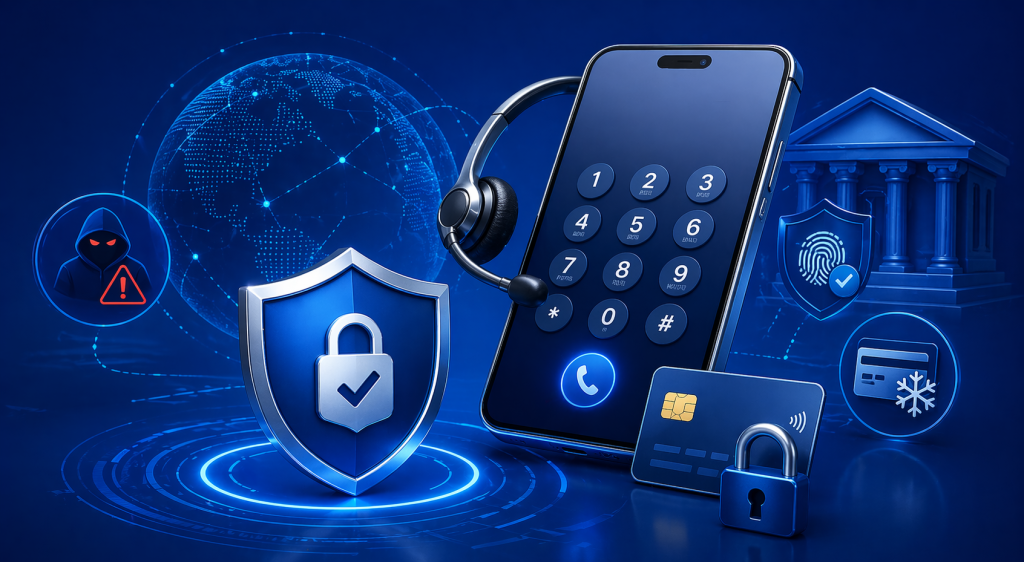
Customers can block a lost debit or credit card—or temporarily freeze an account—directly through IVR keypad inputs, significantly reducing the window of opportunity for fraudsters.
Two‑factor and voice‑based authentication
AI‑powered IVR can combine PINs, one‑time passwords (SMS/email), and voice biometrics to verify the caller’s identity before allowing sensitive actions. This layered approach makes it much harder for impersonators or social‑engineering fraudsters to hijack accounts.
Bank‑Driven Fraud‑Mitigation Actions
Outbound fraud notifications
When a suspicious transaction is detected, the bank can trigger an outbound IVR call to the customer to confirm the payment or issue a warning, with an option to speak to a live agent if needed.
Automated counter‑measures
After repeated failed authentications or suspicious key‑press patterns, the IVR can automatically lock certain services, block further attempts, or escalate the call to the fraud team—ensuring rapid containment without waiting for manual review.
Taken together, these capabilities turn AI‑powered IVR from a simple self‑service channel into a real‑time, intelligent fraud‑control layer that reduces losses, improves response time, and enhances customer trust.
AI‑Powered IVR Supports Fraud Detection
Pattern‑based alerts
Modern IVRs (often AI‑driven) continuously monitor call and transaction patterns, flagging unusual behavior such as multiple failed logins, rapid‑fire transfers, or atypical locations. When anomalies are detected, the system can trigger alerts or enforce extra verification steps automatically.
Real‑time risk scoring
Each call is scored for risk based on factors like caller location, device, behavior, and timing. High‑risk calls are either escalated to fraud specialists or subjected to stricter authentication, while low‑risk calls move smoothly through self‑service.
Real Impact on BFSI Operations
Banks implementing AI-powered IVR are already seeing measurable results:
-
- Up to 78% reduction in fraud attempts
- Authentication time reduced from ~60 seconds to under 5 seconds
- Improved customer experience with fewer friction points
- Reduced dependency on manual fraud detection
More importantly, response time improves dramatically. Customers can instantly block cards, secure accounts, or report suspicious activity—without waiting in queues.
Beyond Detection: A Strategic Advantage
Modern contact center platforms like Dialshree by Elision Technologies go beyond fraud detection.
They enable banks to unify all communication channels—voice, chat, email, and social—into a single intelligent system, ensuring seamless customer interaction and better control over security.
With built-in AI capabilities, workflow automation, and CRM integrations, banks can:
-
- Automate fraud response workflows
- Gain a 360° view of customer interactions
- Detect fraud patterns across thousands of touchpoints
- Improve operational efficiency while reducing costs
Organizations using such omnichannel solutions have reported increased productivity, better resource utilization, and improved customer satisfaction—all while strengthening security frameworks.
The Road Ahead
The fraud landscape will only become more complex. As attackers adopt AI, banks must do the same to stay ahead. The shift is clear:
-
-
From reactive detection → proactive prevention
-
From manual checks → intelligent automation
-
From fragmented systems → unified communication platforms
-
RBI is already steering this transformation in India. The regulator has mandated that banks adopt AI‑and machine‑learning‑driven tools like MuleHunter to detect and act on suspicious accounts, mule‑networks, and fraudulent transaction patterns in real time. This doesn’t just apply to core banking and payment switches—AI‑enabled IVR systems are increasingly expected to align with these frameworks, turning voice channels into compliant, risk‑based control points. When MuleHunter flags a high‑risk pattern, AI‑IVR can block or escalate calls instantly, ensuring that regulatory mandates translate into on‑the‑ground fraud prevention.
Banks that invest in advanced communication technology today will not only reduce fraud losses but also build long‑term customer trust. Those who delay? They risk falling behind—both in security and customer experience.
The Real Question Isn’t “If”—It’s “How Fast”
The technology to prevent a significant portion of this fraud already exists. The only difference between leading banks and struggling ones is how quickly they act.
While some institutions are already leveraging AI-powered systems to detect and stop fraud in real time, others are still relying on outdated methods—leaving gaps that fraudsters are actively exploiting.
And here’s the reality:
Every delayed upgrade = increased exposure.
Every missed detection = financial loss.
Every poor experience = lost customer trust.
Take Action Before Fraudsters Do
With proven deployments across 900+ enterprise communication solutions globally, Elision Technologies is already helping BFSI organizations modernize their communication infrastructure and strengthen fraud prevention strategies.
Solutions like Dialshree are designed to be:
- Scalable (cloud or on-premise)
- AI-driven and automation-ready
- Seamlessly integrated with existing systems
Meaning—you don’t need a complete overhaul to start. You just need to start.
Final Thought
Fraud isn’t slowing down. It’s evolving.
The question is—are your systems evolving faster?
#AIFraudDetection #BankingSecurity #Dialshree #ElisionTech #VoiceBiometrics #IVR #BFSI #FraudPrevention #ContactCenter