

Why Banks Are Moving to WhatsApp-First Customer Communication Globally
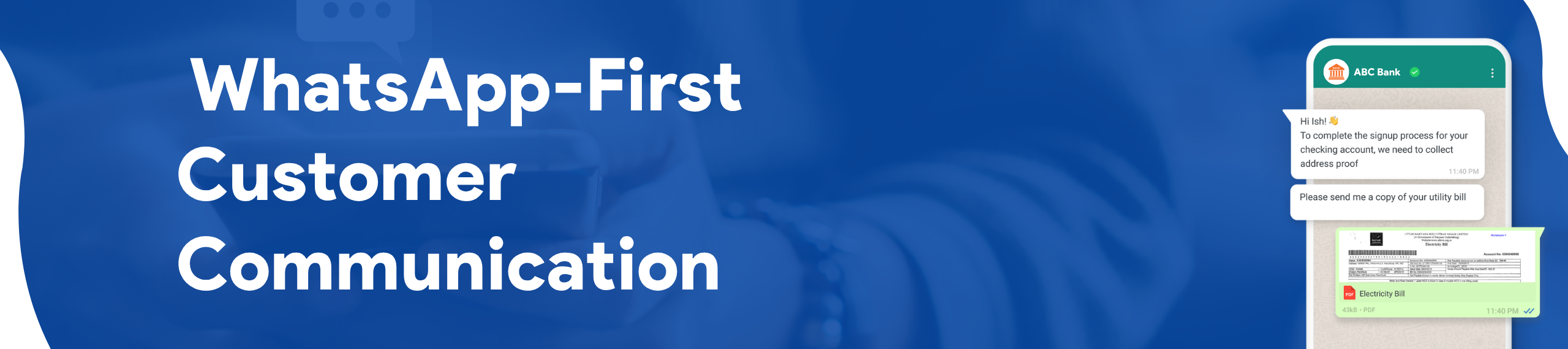
WhatsApp Banking is transforming how financial institutions communicate with customers. Instead of relying on traditional channels like SMS, IVR, emails, and branch visits, banks and NBFCs are now enabling customer interactions directly through WhatsApp for support, KYC, payments, reminders, onboarding, and authentication.
As customer expectations shift toward instant and conversational experiences, WhatsApp-led communication is becoming a key part of digital banking strategies in India.
With massive WhatsApp adoption across urban and rural India, financial institutions now have the opportunity to create more accessible, scalable, and customer-friendly banking experiences.
Why WhatsApp is the new front door for banking
Banks have traditionally depended on multiple communication channels — SMS for OTPs, calls for customer support, branches for KYC, and emails for updates. But for customers, this often means switching between platforms, repeating information, and dealing with slow or disconnected experiences.
WhatsApp is changing that.
With more than 500 million users in India and extremely high engagement rates, WhatsApp has become the platform customers already use every day. Instead of asking users to move across apps, websites, calls, and emails, banks can now deliver support, authentication, KYC, reminders, and service journeys within a single conversation.
For banks and financial institutions, this means:
- Faster customer communication
- Better engagement rates
- Reduced support workload
- More seamless digital experiences
WhatsApp Banking is no longer just an additional support channel — it is becoming the primary digital touchpoint for modern banking communication.
Passive vs active WhatsApp banking: understanding the two modes
Passive (always-on) WhatsApp banking
Passive WhatsApp banking runs in the background without requiring the customer to initiate anything. The bank sends proactive, contextual messages — transaction alerts, EMI reminders, fraud warnings, statement delivery, and loan offers — directly to the customer's WhatsApp. No app download. No login. No SMS that never arrives.
This mode mirrors how the best consumer brands communicate: timely, personal, and on the platform the customer already uses. For BFSI, it replaces the unreliable SMS layer with a delivery-guaranteed, read-receipt-enabled communication thread.
Active (passphrase) WhatsApp banking
Active WhatsApp banking places the customer in the driver's seat. A customer sends a predefined passphrase — 'BAL' for balance, 'STMT' for statement, 'BLOCK' to stop a card — to the bank's verified WhatsApp number. The system authenticates the request, validates the session, and responds within the encrypted chat thread.
More advanced implementations layer voice biometrics onto this model — removing PINs, passwords, and security questions entirely. The customer speaks a short phrase; the system matches the voiceprint in under 10 seconds; the transaction is authorised. No credential to steal. No question to forget.
How Traditional ways are replacing with Modern Technology
The SMS OTP model is broken. Delivery rates hover between 70-80%, telecom networks are unreliable during peak hours, and SIM-swap fraud has made SMS authentication a known vulnerability. The Reserve Bank of India has already signalled the need for stronger authentication frameworks.
WhatsApp authentication messages offer a direct replacement. Here is how the flow works:
- Customer initiates a transaction on net banking or mobile app
- Bank triggers a WhatsApp authentication message to the verified number
- Customer confirms via a one-tap reply or passphrase within the encrypted chat
- Session is authenticated — no OTP to copy, no SMS to wait for, no telecom dependency
For NRI customers in the UAE, USA, or anywhere globally, this is transformative. WhatsApp functions on Wi-Fi and data — no roaming dependency, no international SMS failure. A customer in Dubai can authenticate a NEFT transfer to India as seamlessly as a customer sitting in Mumbai.
Conventional banking vs WhatsApp banking
| Parameter | Conventional Banking | WhatsApp Banking |
| Customer authentication | SMS OTP (delays, delivery failures) | Passphrase on WhatsApp (instant, encrypted) |
| KYC process | Branch visit or email PDFs, 3-5 days | Document collection on WhatsApp, same day |
| Contact centre | Call queues, high abandon rate | WhatsApp chat, 77% first-contact resolution |
| OTP delivery rate | ~70-80% (telecom dependent) | ~98% (internet-based, global) |
| NRI / global access | SMS fails on roaming | WhatsApp works everywhere |
| Compliance trail | Fragmented — call recordings, emails | Single searchable chat thread |
| Cost per interaction | High (agent + infrastructure) | Low (automated + async) |
| Customer experience | Reactive, channel-hopping | Proactive, always-on messaging |
Ready to define WhatsApp banking for your institution?
Elision is the Indian CCaaS provider building WhatsApp-first communication infrastructure for BFSI integrating with your CRM.
Whether you are a PSU bank looking for Modern Business Communications, a private bank scaling contact centre efficiency, or a fintech targeting the NRI corridor — the architecture is ready.
Talk to Elision Team — India · UAE · USA · Global
© Elision Technologies | WhatsApp Banking | BFSI