

OTP Delivery in India: Why Banks Are Engineering SMS Like a Trading System
UPI crossed 24,000 crore transactions in FY 2025–26. That's over 20 billion authentications every single month — each one dependent on an OTP reaching the right handset, on the right network, in under three seconds.
Miss that window consistently, and you're not just losing transactions. You're losing customers — and as of April 2026, you're also in direct conflict with RBI's new authentication framework.
UPI-scale banking requires OTP delivery in milliseconds — forcing banks to redesign SMS infrastructure for latency, compliance, and telecom resilience.
The Number Nobody Talks About
A 1% OTP failure rate across UPI's current volume equals roughly 200 million failed authentication events per month. Each one is a dropped transaction, a support ticket, or a fraud escalation waiting to happen.
OTP delivery isn't a messaging problem. It's a conversion problem — and from April 2026, a compliance one too.
What RBI Actually Requires in 2026
This is where most published content gets it wrong.
RBI has never mandated a specific OTP delivery time. What changed significantly is the Authentication Mechanisms for Digital Payment Transactions Directions, 2025, effective April 1, 2026. The framework mandates:
- Two-factor authentication for all domestic digital payments — no exceptions
- At least one dynamic factor — meaning unique to each transaction, non-reusable (OTP qualifies; static PIN alone does not)
- Risk-based authentication — issuers must assess transaction context (device, location, behaviour) and apply appropriate friction
- Issuer liability — if your authentication fails and fraud occurs, the bank compensates the customer
Critically, the 2026 directions move away from OTP-only compliance. Biometrics, device tokens, in-app prompts, and hardware tokens are now equally valid. Banks that treat "send an OTP" as sufficient compliance are already behind.
Industry benchmarks banks still self-impose for OTP-based flows:
- OTP generation: <100ms
- Gateway processing: <300ms
- Handset delivery: <3 seconds
- Delivery success rate: >99%
Miss these consistently and you're not just underperforming — you're generating the exact authentication failures the April 2026 directions were written to eliminate.
Where Most Banks Are Getting It Wrong
Route mismatch is the silent killer. Banking OTPs must travel transactional SMS routes — not promotional. Transactional routes deliver to DND subscribers 24/7. Promotional routes don't. Routing OTPs down the wrong pipe means systematic delivery failure for a large slice of your customer base, with no error signal on your end.
DLT is a governance problem, not a setup task. TRAI mandates that every banking OTP pass through DLT-registered infrastructure — entity, sender header, template, variables, all of it pre-approved. A single word change in an OTP message that doesn't match the registered template gets silently blocked at the telecom scrubbing layer. No delivery. No alert. Just a customer who never got their OTP.
Most banks set up DLT once and forget it. Template drift — a copy edit, a compliance update, a product rename — kills delivery at scale before anyone notices.
How Banks Actually Route OTPs
Single-provider SMS is a liability. High-volume banks run intelligent routing engines that dynamically select paths by operator, region, real-time latency, and historical success rates — direct SMPP to Airtel for one segment, Jio for another, backup aggregator for congestion scenarios.
When SMS fails beyond SLA thresholds, failover kicks in automatically:
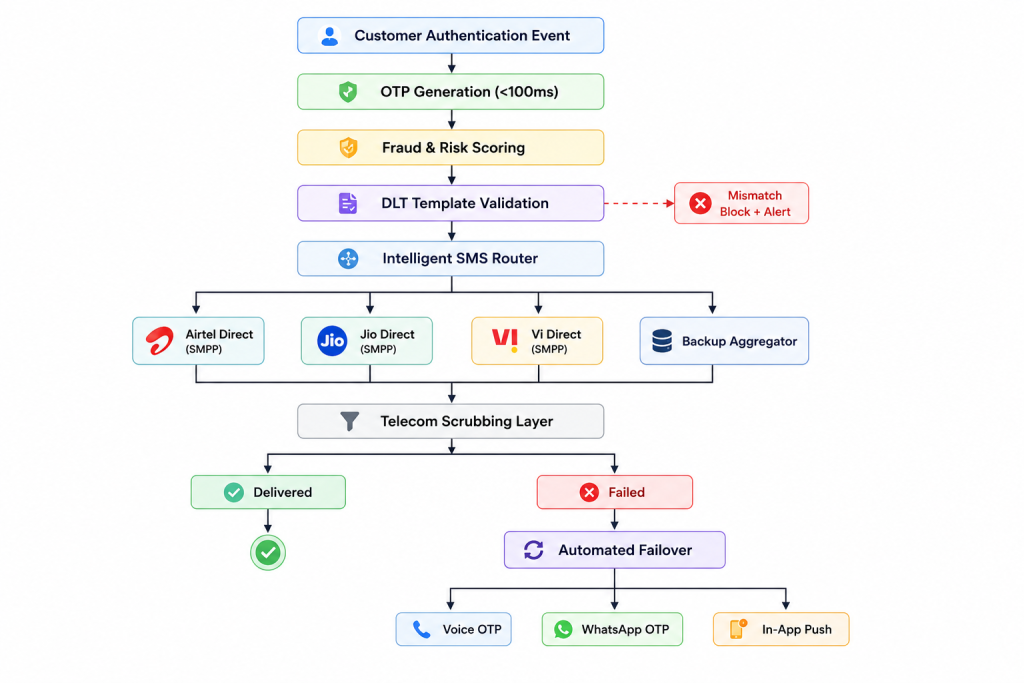
Multi-channel redundancy isn't optional anymore. Under RBI's 2026 framework, authentication failure that leads to customer loss is the issuer's liability. Your failover architecture is now a compliance control, not just an engineering nicety.
The Congestion Problem Nobody Plans For
Salary day. IPL finals. Festive sales. OTP volume spikes, telecom networks congest, and delivery times jump from milliseconds to seconds. Banks without congestion-aware routing absorb this passively — and their transaction success rates show it.
In January 2026, UPI processed 21.7 billion transactions in a single month. The daily average was 698 million transactions. Peak-day spikes above that baseline are predictable. The calendar doesn't change. Plan the infrastructure accordingly.
The Shift Already Underway
The 2026 RBI directions are an explicit signal: India's authentication future is not SMS-first. Device binding, silent network authentication, biometrics, in-app push — these are now formally recognised authentication factors, not workarounds.
For banks, this creates a real architecture decision. Rebuilding OTP infrastructure for sub-3-second delivery while simultaneously standing up biometric and token-based authentication isn't a future project anymore. The compliance deadline already passed.
SMS OTP will remain essential for UPI onboarding, device changes, and cross-device verification for the foreseeable future. But the banks winning on transaction success rates are the ones treating authentication as a full-stack infrastructure problem — not a messaging function with a failover switch.
The April 2026 framework didn't change the goal. It just made the cost of ignoring it explicit
For BFSI, a delayed OTP doesn't just break the payment flow — it breaks the customer contact window. Elision Technologies partners with BFSI institutions as a licensed VNO to ensure compliant, sub-second OTP delivery across every collection touchpoint, from first notice to final resolution.