

Why Elision DialShree Awarded as the Best AI Collections Platform
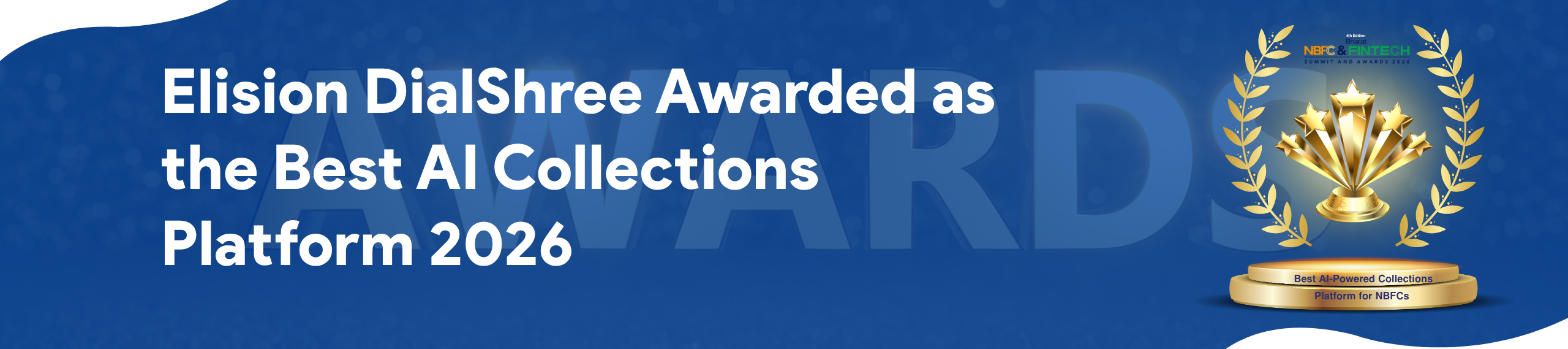
Elision DialShree has been named Best AI-Powered Collections Platform for NBFCs at the NBFC & Fintech Summit and Awards 2026. It's a nice moment to stop and say out loud what usually only shows up in release notes: this module wasn't designed on a whiteboard in one sitting. It was built brick by brick, mostly at the request of NBFCs who told us exactly where the old way of collecting was breaking down.
Elision DialShree Named Best AI-Powered Collections Platform for NBFCs
The award was presented to Elision Technologies Private Limited, recognizing the Collection Module inside DialShree — the piece of the platform built specifically to help NBFCs recover EMIs at scale without losing the compliance discipline that regulators, and honestly good practice, demand.
 >
>
A Collection Module Built Brick by Brick, Not Designed in a Vacuum
Most collections software gets pitched around a feature list. Ours is easier to explain as a story, because that's genuinely how it grew. Our deployments with NBFCs — didn't just prove the product worked. It told us what to build next.
How Dvara KGFS Put AI to Work Across Five Languages — and Without Hiring a New Agent
Dvara KGFS serves rural households across India — borrowers spread across multiple geographies, speaking five different languages, at every stage of the loan journey. Managing loan qualification and EMI collection at that volume manually wasn't just slow. It was a structural ceiling on how fast the business could grow.
What we built for them became a core brick in the module: Hindi, English, Kannada, Telugu, and Malayalam running simultaneously, with zero routing delay and no transfer between agents or bots — the language is detected straight from the borrower's profile the moment the call connects.
That deployment now handles roughly 1 lakh borrower conversations a month, with the AI voicebot contributing 45% of total calling volume, freeing human agents for the complex, judgment-call cases that actually need a person. Automated, validated data capture (occupation, income, overdue history) replaced manually-entered fields that used to vary by agent, and collection conversions improved by 11% as a direct result/PTP Confirmation. More than 6,700 Promise-to-Pay commitments have been logged automatically, without a single new agent hired to manage the volume.
Read the full Dvara KGFS case study →
What's Inside the Collection Module Today
Put together, those two deployments — plus a long list of smaller feedback loops from other clients — are what the Collection Module actually looks like now:
- No borrower gets a script that doesn't fit them — a Human Line Voicebot leads every call sounding like a trained collections agent, not an IVR menu, switching language in real time based on how the borrower is actually speaking rather than a language picked before the call even dialled.
- Nobody has to repeat themselves across channels — Voice, WhatsApp Business, and Email aren't three separate silos here; they're one contextual conversation. If a payment link went out over WhatsApp and sat unclicked, the next voice call already knows that and opens accordingly, instead of starting the pitch from zero.
- A blocked number doesn't take an account off the list — Number Shuffling rotates the outbound caller ID and automatically attempts alternate numbers on file the moment connectivity drops on one, so a single screened call doesn't stall an entire campaign for that borrower.
- Every account gets followed up on its own terms — disposition-based follow-ups mean a "promise to pay" account and a "no response" account are never handled the same way twice; the next action — a reminder, a renegotiation call, an escalation — is routed automatically based on what actually happened on the last attempt.
- Field agents never start a visit blind — when an account's disposition calls for a doorstep visit, the Collection Module doesn't wait for someone to notice and hand it off manually. It sends the intimation straight to the FOS (feet-on-street) team, so field agents arrive already knowing the account's latest status instead of re-asking questions the call centre already answered.
- AI Voice Analysis, tuned by risk — not a spot check — Most collections floors QA a manually-sampled slice of calls, maybe 5–10%, and hope the rest went fine. That's a blind spot on the calls that matter most. The moment a human agent picks up with a debtor, DialShree's AI Voice Analysis engine is already listening — scoring tone, script adherence, and compliance flags on 100% of human-agent calls, not a sample. Layer in Smart Bucketing and the review gets sharper still: every call inherits the borrower's risk bucket — 0–30, 30–60, 60–90, or 90+ DPD — so a tense 90+ DPD escalation surfaces to a supervisor within minutes, while a routine 0–30 DPD reminder doesn't sit in the same review queue. Supervisors stop hunting through call logs for the one that went wrong. The system already knows which one to show them.
- Nothing falls through a gap between systems — bidirectional CRM sync writes confirmations, objections, PTP dates, and transcripts back automatically, with no manual data entry step to introduce errors.
Built on a Compliant Foundation
None of the above works without the infrastructure underneath it. Elision holds a VNO (Virtual Network Operator) license from the Department of Telecommunications, which is what lets DialShree run collections calling on properly licensed, auditable telecom infrastructure rather than routing through third-party gateways. On top of that sits 1600-series compliance — the TRAI-mandated number series for BFSI transactional communications — enforced at the system level on every collections campaign, not left to agent discipline. Today, that combination is part of why the platform is trusted by 1,200+ BFSI clients across India.

|

|

|
|

|
|
Looking Ahead
Every brick in this module started as a specific problem a specific NBFC brought to us. That's not going to change just because there's now an award on the shelf — the roadmap is still driven by the next deployment that finds the next gap.
Curious what the AI Collection platform could do with your DPD buckets and borrower base?
Frequently Asked Questions
-
How is AI voice analysis different from call recording?
Call recording stores a conversation so it can be retrieved later. AI voice analysis understands the conversation as it happens — reading sentiment, intent, and compliance risk in real time and triggering actions during the call, not after. Recording is storage. AI voice analysis is intelligence.
-
Does it replace supervisors?
No — it changes what supervisors do. Instead of spending hours listening to randomly selected calls, supervisors receive a ranked, AI-prioritised list of the calls that actually need a human decision. Their time moves from sampling to reviewing, from guessing to acting on evidence.
-
How does it handle compliance requirements specific to India?
The system is configured for RBI Fair Practices Code requirements, TRAI-compliant language standards, and IRDAI regulations. Specific phrases and conduct guidelines relevant to Indian BFSI operations are built into the compliance monitoring layer — flagged in real time, logged automatically, and available in an organised, searchable format for audit purposes.
-
How are post-call scores used?
Every call receives an automatic score across configurable parameters: sentiment arc, compliance adherence, script adherence, objection handling, and outcome. Supervisors see a ranked list of calls that need review. Training managers see patterns across the full call population — which agent behaviours correlate with resolution, which call types generate repeat contacts, where coaching priorities actually lie.