

Zero-Trust Security for Multi-Client BPO Contact Centers: Protecting Client Data
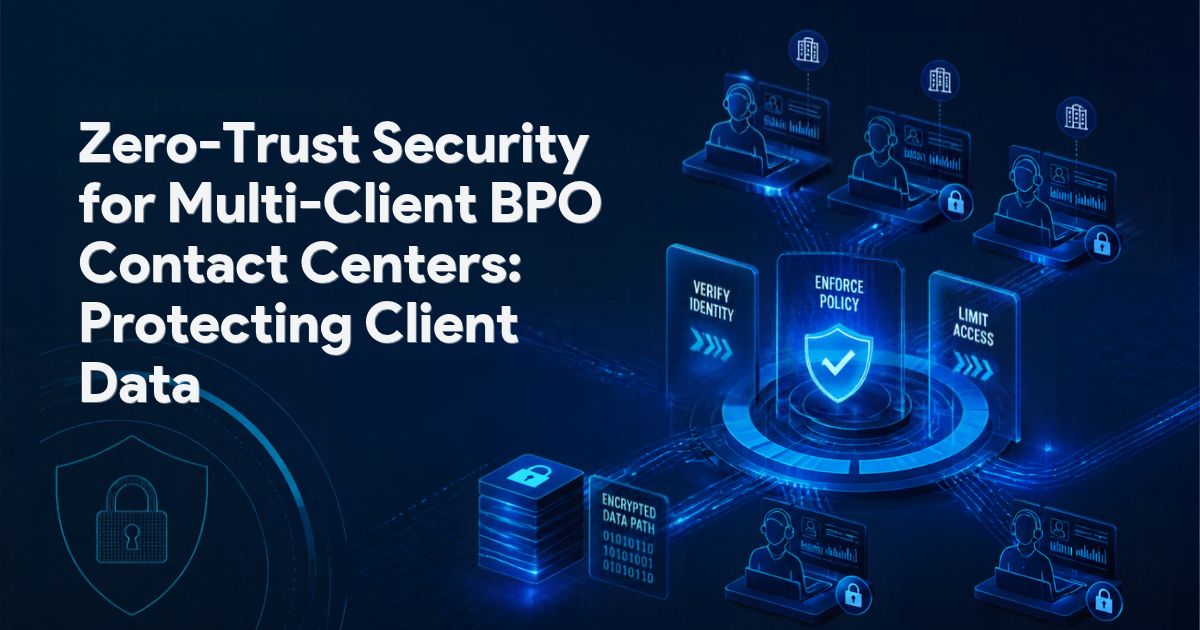
Zero-trust security for a BPO contact center means no user, device or network is trusted by default: every agent, supervisor and system must prove who they are and what they’re allowed to see each time they connect, and access is limited to one client’s data at a time.
Key takeaways
- The old “trusted office network” model fails for BPOs, which run many clients, remote agents and high staff turnover.
- Zero trust rests on one rule: never trust, always verify, then give the least access needed.
- Five controls matter most in a contact center: identity-based access, per-session checks, encrypted recordings, data-loss prevention on agent screens, and audit-ready evidence.
- One breach can cost a BPO more than money. It can cost the client.
- You don’t need to do everything at once. A four-level maturity checklist below shows where to start.
“Our client’s security team just sent a 200-question audit form. Half of it is about who can see what, from where, and how we’d know.” — a BPO compliance head, last quarter
Every BPO handles somebody else’s customers. Bank balances, medical details, card numbers, addresses. When that data leaks, the client doesn’t just blame the attacker. They blame you. IBM’s Cost of a Data Breach research put the global average at about $4.45 million per incident in its 2023 edition , and the hidden cost for a BPO is lost contracts.
$4.45Maverage cost of a data breach (IBM, 2023 edition)
5controls that cover most contact center risk
1 rulenever trust, always verify
0shared logins in a mature setup
What is zero-trust security for a BPO contact center?
Traditional security worked like a castle. A strong wall and a moat outside, and once you were inside, you were trusted. Zero trust assumes the wall has already been breached. Think of an office building where your badge opens only the floors you need, gets checked at every door, and stops working the moment something looks wrong.
The US National Institute of Standards and Technology (NIST) describes it in Special Publication 800-207 as a model that removes implicit trust and continuously evaluates every request. For a BPO contact center, that translates into practical rules: verify the person, verify the device, limit what they can see, record what they do, and re-check often.
Why do BPOs need zero trust more than most businesses?
- Many clients, one platform. A mistake in access control can expose one client’s data to another client’s agents.
- High attrition. Accounts need to be created and removed constantly. Forgotten logins are an open door.
- Remote and hybrid agents. Home networks, personal devices and shared spaces are outside your control.
- Sensitive data on every call. Card numbers, IDs and health details are spoken and typed all day.
- Client audits. Clients expect proof of controls, not promises.
- Insider risk. Most BPO incidents aren’t hackers. They’re screenshots, phone photos and copied data.
What does zero trust look like in a contact center?
1. Identity-based access: who are you, and what’s your role?
Every person gets their own login, tied to their role and their client. No shared accounts. Multi-factor authentication (MFA) for supervisors and admins at minimum. Access follows “least privilege”: an agent on Client A’s campaign sees Client A’s data and nothing else, and access ends the day they leave.
How DialShree handles it
DialShree separates access through three applications, Admin, Supervisor and Agent, so each user only gets the tools their role needs. The CRM-CTI connector lets agents access client data securely through single sign-on, and DialShree can be deployed on the cloud, on-premise or in a hybrid model, which helps when a client wants data to stay within defined boundaries.
2. Per-session authentication: verify again, every time
Trust shouldn’t last forever. Zero trust re-checks at each new session and when risk changes: a new location, an unfamiliar device, an unusual time. In practice that means session timeouts, restrictions on where agents can log in from, and checks that the device meets your standards before it connects.
How DialShree handles it
For remote agents, DialShree’s work-from-home module and DialShree Mobi app are designed to deliver calling with enterprise-grade security, so access is governed centrally instead of through software installed on loose personal machines.
3. Call recording encryption: protect the audio and the transcript
Recordings are a goldmine for training and disputes, and for attackers. They should be encrypted while moving across the network and while stored, with keys managed carefully, access logged, and retention set per client. Delete when the contract says so, not when someone remembers.
How DialShree handles it
DialShree records calls and stores them securely, with recording playback available by role, so access to audio can be limited to the people who need it.
4. Screen capture and data-loss prevention (DLP)
The easiest way to steal data from a BPO is also the simplest: take a photo of the screen. DLP covers the gap with layers. Screen recording or monitoring for sensitive campaigns, masking of card and ID numbers on the agent screen, pause-and-resume recording during payment capture, blocked copy-paste, USB and printing, and clean-desk policies enforced with cameras and floor audits where the contract requires.
How DialShree handles it
DialShree offers number masking and profile masking, which keep personally identifiable information (PII) hidden from agents who don’t need to see it. Its voice analysis and monitoring module checks that agents follow the right procedures on calls, and AI voice analysis can flag compliance misses across calls rather than a small sample.
5. Audit readiness: SOC 2, ISO 27001 and client reviews
Zero trust only helps if you can prove it. Auditors look for access reviews, change logs, incident records, training records and evidence that controls ran every month, not just on audit day. Treat evidence collection as a routine job, and the 200-question client form becomes an afternoon, not a month.
How DialShree handles it
DialShree’s reports and call logs give a trail of who handled which interactions, which supports client audits and internal reviews.
Have a client audit coming up? See how DialShree protects client data in BPO operations through masking, role-based access and secure remote working, or ask us for a security walkthrough.
Which standards and regulations apply?
| Regulator / standard | Instrument | What it means in practice |
|---|---|---|
| Government of India (MeitY) | Digital Personal Data Protection Act, 2023 and Rules | Lawful processing, security safeguards and breach handling for personal data. Check current phase-in dates. |
| CERT-In | Cyber security directions (2022) | Report specified incidents quickly (the directions set a 6-hour window) and keep logs for a prescribed period. |
| PCI SSC | PCI DSS | Protect card data: no card numbers in recordings, tight access, masked screens. |
| US HHS | HIPAA | Safeguards for health information handled for US healthcare clients. |
| EU / UK | GDPR and UK GDPR | Data subject rights, lawful basis and cross-border transfer rules. |
| ISO | ISO/IEC 27001 | An information security management system, independently certified. |
| AICPA | SOC 2 | An auditor’s report on security and related controls over time. |
Legal requirements change. Have your compliance lead review the regulatory references before you act on them, especially the DPDP Rules timeline and CERT-In directions.
Zero-trust maturity framework: where are you today?
You don’t need to leap to the top. Find your level, then fix the gaps one by one.
| Level | Identity | Devices and sessions | Data | Monitoring |
|---|---|---|---|---|
| 1. Basic | Individual logins, some shared accounts remain | Office-only access, no device checks | Recordings stored with basic access controls | Manual log checks |
| 2. Managed | No shared accounts, role-based access, MFA for admins | Session timeouts, IP restrictions | Encryption at rest, per-client retention | Monthly access reviews |
| 3. Defined | MFA/SSO for everyone, automatic deprovisioning | Device checks for remote agents, per-session re-authentication | Masking, pause-resume recording, DLP controls | Central logs, alerts on unusual access |
| 4. Optimized | Risk-based access that adapts in real time | Continuous posture checks | Per-client keys, automated retention and deletion | Continuous evidence for SOC 2 / ISO 27001, tested incident drills |
Self-check: tick what’s true today
- ☐ Every user has an individual login; no shared accounts
- ☐ Access is limited by role and by client
- ☐ MFA is on for admins, supervisors and remote agents
- ☐ Leavers lose access the same day
- ☐ Recordings are encrypted in transit and at rest
- ☐ Card and ID data is masked or paused from recording
- ☐ Copy-paste, USB and printing are controlled on sensitive campaigns
- ☐ Access reviews happen at least quarterly
- ☐ Logs are kept centrally and checked
- ☐ You’ve rehearsed what to do in a breach
Zero to three ticks means you’re at level 1. Four to six is level 2. Seven to nine is level 3. All ten with evidence is level 4.
How can a BPO start zero trust in 90 days?
- Days 1–15: Find the sprawl. List every system, every user, every shared login and every client’s data location.
- Days 15–30: Fix identity first. Remove shared accounts, turn on MFA for privileged users, tidy roles per client.
- Days 30–60: Protect the data. Encrypt and set retention on recordings; add masking and pause-resume for payment and ID capture.
- Days 60–75: Control the endpoints. Session timeouts, location limits and DLP controls for remote and high-risk campaigns.
- Days 75–90: Prove it. Run an access review, test an incident drill and collect evidence for your next client audit.
Why work with Elision?
- Built with BPOs in mind. Our BPO/KPO solution includes number masking and profile masking for PII, role-based Admin, Supervisor and Agent applications, a work-from-home module with enterprise-grade security, and a Master Server designed for high process uptime.
- Your deployment, your call. Cloud, on-premise or hybrid, depending on where a client says data must live.
- Scale. More than 25,000 users across 50 countries.
- Straight talk. We’ll tell you where a control sits with us and where it sits with you.
Glossary
- Zero trust
- A security model that verifies every user and device on every request, rather than trusting anything inside a network.
- Least privilege
- Giving people only the access they need for their job.
- MFA
- Multi-factor authentication: two or more proofs of identity, such as a password and a one-time code.
- DLP
- Data loss prevention: controls that stop sensitive data leaving the organisation.
- SOC 2
- An independent audit report on a service provider’s security controls.
- ISO 27001
- An international standard for managing information security.
- Multi-tenant
- One platform serving many clients, with each client’s data kept separate.
FAQs
What is zero-trust security for a BPO contact center?
It’s a security approach where nobody is trusted by default. Every agent, supervisor and device is verified for each session, given access only to one client’s data, and monitored, so a single compromised account can’t expose everything.
Is zero trust a product I can buy?
No. It’s a strategy made of many controls: identity, device checks, encryption, monitoring and policy. Vendors can supply parts of it, but you still design and run the whole.
Does zero trust work for remote and work-from-home agents?
Yes, and it’s a good fit. Because it doesn’t depend on a trusted office network, it applies the same checks wherever the agent logs in from.
Do I need SOC 2 or ISO 27001 to win BPO clients?
Many enterprise and international clients ask for one or both. They aren’t legal requirements everywhere, but they’re the common way to prove your controls to a client.
How should call recordings be protected?
Encrypt them in transit and at rest, limit who can play or download them, log all access, mask or pause recording for card details, and delete them on the schedule the client contract sets.
Let’s walk through your security questions
Bring the audit form your toughest client sent you. We’ll show you what DialShree covers, and be upfront about what sits outside it.
Trusted by 25,000+ users across 50 countries.
About this guide. Written by the Elision Technologies team. Last reviewed October 2026 and reviewed at least every six months. This guide is general information, not legal or security advice. Related reading: DialShree for BPO/KPO.
Sources and references
- IBM, Cost of a Data Breach Report: ibm.com/reports/data-breach
- NIST Special Publication 800-207, Zero Trust Architecture: csrc.nist.gov
- Ministry of Electronics and IT, Digital Personal Data Protection Act, 2023: meity.gov.in
- CERT-In: cert-in.org.in
- PCI Security Standards Council: pcisecuritystandards.org
- ISO/IEC 27001: iso.org
- AICPA, SOC 2: aicpa-cima.com
Contact Us
Our experts can resolve your customer engagement issues
Book a free consultation with our expert and see why more than 25000 users across 50 countries trust Elision for their communication needs.