Fraud Blocker

Auto Dialer Software for African Call Centers: The Complete Guide

Your outbound team is making calls. But how many of those calls are actually conversations?

In most African call centers — whether in Lagos, Nairobi, Johannesburg, or Accra — agents spend 40 to 60 percent of every shift dialing numbers, waiting through rings, navigating busy tones, and leaving voicemails.

By the time they finish a full hour, they’ve had maybe 12 minutes of real conversation.

That’s not a people problem. That’s a dialing problem.

Auto dialer software fixes it at the root — and across Africa, where outbound calling is the backbone of banking, collections, insurance, and BPO operations, the teams that have made the switch are reaching 3 to 4 times more customers on the same headcount.

What Is Auto Dialer Software?

Auto dialer software is an outbound calling system that automatically dials phone numbers from a contact list and connects answered calls to available agents.

It eliminates manual dialing, filters unanswered and disconnected calls, and ensures agents spend their time in live conversations rather than waiting for calls to connect.

The core difference from manual calling: agents only pick up when a real person answers. Every ring, busy signal, voicemail, and disconnected number is handled by the system — without consuming a second of agent time.

Why African Call Centers Need Auto Dialers More Than Most

High Mobile Penetration, Low Answer Rates

Africa has over 600 million mobile subscribers. But answer rates on cold outbound calls average 20 to 30 percent — meaning agents manually dialing cold lists spend 70 to 80 percent of their time on unproductive dials.

An auto dialer filters all of that automatically.

Multi-Language and Multi-Region Operations

A collections team in South Africa may need to reach customers speaking Zulu, Xhosa, Afrikaans, and English. A Nigerian bank serves Hausa, Yoruba, and Igbo speakers.

Auto dialers with language-based routing ensure customers reach agents in their preferred language — without manual intervention.

Power and Connectivity Variability

African operations often deal with intermittent connectivity and load shedding.

Cloud-based auto dialers with failover routing maintain campaign continuity even when local infrastructure fluctuates — something on-premise systems can’t reliably deliver.

Regulatory Compliance

South Africa’s POPIA, Nigeria’s NDPR, Kenya’s Data Protection Act, and various national DNC frameworks require compliant outbound calling practices.

Purpose-built auto dialers include DNC filtering and call recording for audit compliance.

How Auto Dialer Software Works — Step by Step

Step What Happens Result
1. Upload Contact List Import from CRM, Excel, or database. Syncs live via API. Always working from current data
2. System Dials Automatically Dials simultaneously, detects voicemails, skips disconnected numbers, filters DNC. Zero agent time on dead dials
3. Call Screened Live person or voicemail detected. Machines dropped or receive auto-message. Only real conversations reach agents
4. Agent Connects Instant bridge to live answer. No dead air. No delay. Agent hears a real person immediately
5. Outcome Logged Call result, notes, and next actions written to CRM automatically. Zero manual data entry


Result:
 Agents go from 12 minutes of talk time per hour to 45–55 minutes. That is a 3x–4x productivity increase on the same headcount.

Types of Auto Dialers — Which One Does Africa Need?

Dialer Type How It Works Best For Talk Time
Predictive Dials 3–4 numbers per agent simultaneously High-volume collections, insurance, lead generation 45–55 min/hr
Progressive Dials one number when agent becomes available Collections follow-up, account management 35–45 min/hr
Preview Agent reviews customer record before call placement High-value accounts, complex negotiations 25–35 min/hr
Power Dials sequentially as agent finishes SMB sales, lower-volume campaigns 30–40 min/hr
Voice Broadcasting Pre-recorded messages sent to large contact lists Payment reminders, alerts, notifications N/A

Who Uses Auto Dialers in Africa — and What They Achieve

Banks and Financial Institutions

African banks run high-volume outbound campaigns for loan renewals, credit card activations, account verifications, and customer re-engagement.

A predictive dialer allows a 10-agent team to contact 800 to 1,200 customers per day — compared to 200 to 300 with manual dialing.

Collection Agencies and Debt Recovery

Collections is the most demanding auto dialer use case in Africa. Portfolios of 10,000 to 500,000+ accounts require systematic and timely contact to prevent delinquency migration.

BPOs and Outsourcing Operations

African BPOs serving international clients need productivity metrics that meet global standards.

Auto dialers help increase talk time ratios and improve operational efficiency.

Insurance Companies

Policy renewal campaigns, claims follow-up, and cross-sell programs run efficiently with predictive dialing systems.

What to Look for in Auto Dialer Software for Africa

Criteria Why It Matters
Local Number Support International numbers reduce answer rates significantly
Multi-Language IVR Essential for diverse regional operations
CRM & LMS Integration Eliminates manual export/import processes
Compliance Controls DNC filtering and call recording required
Cloud Reliability Ensures uptime during connectivity disruptions
Supervisor Dashboard Real-time campaign visibility and monitoring
Answering Machine Detection Prevents agents from waiting on voicemails

5 Signs Your African Call Center Needs an Auto Dialer Right Now

  • Your agents are making fewer than 50 outbound calls per hour
  • Your collections team is missing DPD windows
  • Your CRM data is always outdated
  • Your supervisors rely on delayed end-of-day reports
  • Your team spends more time dialing than talking
FAQs
Q: What is auto dialer software?
A: Auto dialer software is an outbound calling system that automatically dials phone numbers from a list and connects answered calls to available agents. It eliminates manual dialing, filters no-answers and busy signals, and ensures agents spend their time in live conversations. In African call centers, auto dialers typically increase agent talk time from 12 minutes per hour to 45–55 minutes per hour.
Q: Is auto dialer software legal in Africa?
A: Yes. Auto dialer software is legal across Africa when used in compliance with national data protection and telecommunications regulations. South Africa requires POPIA compliance, Nigeria requires NDPR adherence, and Kenya requires compliance with the Data Protection Act 2019. Compliant auto dialers include DNC registry filtering, call recording, and configurable call window restrictions.
Q: What is the best auto dialer for African call centers?
A: The best auto dialer for African call centers should support local number series for each target country, offer multi-language routing, include DNC filtering aligned with national regulations, integrate with existing CRM platforms, and provide real-time supervisor dashboards. Cloud-based deployment with offline failover capability is essential given variable infrastructure across African markets.
Q: How much does auto dialer software cost in Africa?
A: Auto dialer software pricing in Africa varies by deployment model and feature set. Cloud-based solutions typically start at USD 15–50 per agent per month for basic functionality, with enterprise platforms including predictive dialing, CRM integration, and compliance controls starting at USD 50–150 per agent per month. On-premise licensing is available for organisations with data sovereignty requirements.
Q: What is a predictive dialer and how is it different from an auto dialer?
A: A predictive dialer is a type of auto dialer that dials multiple numbers simultaneously per agent and uses algorithms to predict when agents will be available — maximising talk time. All predictive dialers are auto dialers but not all auto dialers are predictive. For high-volume African collections and BPO campaigns, predictive dialing delivers the highest productivity gains.
Q: Can an auto dialer integrate with African banking and CRM systems?
A: Yes. Modern auto dialer platforms integrate via REST API with major CRM platforms including Salesforce, HubSpot, and Zoho, as well as custom-built banking and loan management systems. Contact data, call outcomes, and agent notes sync automatically after every call.

Start Reaching More Customers Across Africa

DialShree deploys in 72 hours with local number support, multi-language routing, and compliance controls built for Africa.

Book a Free Demo

Trusted by 2,500+ organisations globally. 100+ deployments across Africa.

Loading

Auto Dialer for NBFC Collections: How to Recover More and Call Smart

In collections, every silent day is a lost rupee.
A borrower who needed a soft reminder last week needs an escalation call this week. And while your team manually dials through thousands of accounts — redialing, leaving voicemails, updating spreadsheets — the DPD clock is ticking on every single one of them.
This is the reality for most NBFCs, microfinance institutions, and collection agencies across India. Not because their teams aren’t working hard. But because the tool they’re using — a phone and a spreadsheet — was never built for the scale they now operate at.
Auto dialer software changes this equation entirely.


What is an Auto Dialer for NBFC Collections?

An auto dialer for NBFC collections is an outbound calling system that automatically dials borrower numbers from a prioritised list and connects live-answered calls to available agents — instantly. Unlike generic dialers, a collections-focused auto dialer integrates with your Loan Management System, segments accounts by Days Past Due (DPD), stays compliant with RBI and TRAI regulations, and ensures your agents spend their time in real conversations — not redialing dead numbers.


The Real Cost of Manual Collections

A 10-agent team dialing manually can realistically contact 200 to 300 accounts per day. That sounds reasonable — until you do the math at portfolio scale.
With 10,000 accounts and 10 agents, a full portfolio pass takes 33 to 50 days manually. By the time you’ve completed it, accounts that were at 30 DPD are now sitting at 90+ DPD. The compounding is brutal.
And it gets worse: agents spend 40 to 60 percent of every shift on unproductive dials — busy signals, no answers, disconnected numbers. In a typical outbound hour, an agent gets only 10 to 15 minutes of actual borrower conversation.
That’s not a team problem. That’s a tool problem.


How Dialshree Auto Dialer Works 

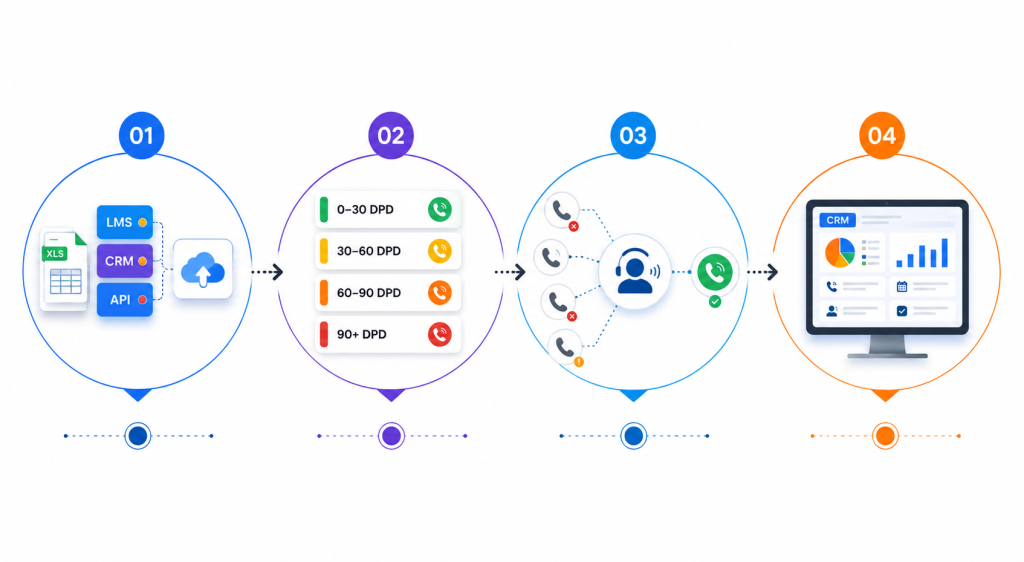
Step 1 — Import Your Portfolio by DPD Bucket
Upload your contact list from your LMS, CRM, or Excel. DialShree syncs via API and automatically organises accounts by DPD bucket — so the system always knows what to prioritise.

Step 2 — DPD-Based Campaign Configuration
Not every borrower needs the same approach. DialShree applies different dialing strategies based on risk:

  • 0–30 DPD → Progressive dialing, soft EMI reminder, prevent migration
  • 30–60 DPD → Predictive dialing, maximum contact rate, PTP capture
  • 60–90 DPD → Preview mode, agent reviews account before dialing
  • 90+ DPD → Manual with auto-logging, specialist escalation track

Step 3 — Predictive Dialing Maximises Talk Time
For high-volume campaigns, DialShree dials 3 to 4 numbers simultaneously per agent. Busy signals, no-answers, disconnected numbers, and answering machines are filtered out automatically. Only live-answered calls connect to an agent. Talk time jumps from 10–15 minutes to 45–55 minutes per hour — on the same shift, with the same team.

Step 4 — Automatic LMS and CRM Sync
Every call outcome — status, duration, Promise to Pay date, agent notes, next action — writes back to your LMS automatically after every call. No manual data entry. Portfolio status is always current, always accurate.

Dialshree vs Manual Calling — The Numbers

Metric Manual Dialing DialShree Auto Dialer
Accounts contacted / agent / day 30–40 120–150
Agent talk time per hour 10–15 minutes 45–55 minutes
Portfolio pass (10k accts, 10 agts) 33–50 days 8–10 days
TRAI 9 AM–9 PM calling window Manual check Auto-enforced
1600 series compliance Manual configuration Built in
PTP capture Inconsistent Standardised, auto-logged
Call recording Inconsistent 100% of all calls
RBI audit readiness Manual compilation Instant pull by account
CRM / LMS sync Manual export/import Real-time API sync
Deployment time 48 hours


RBI and TRAI Compliance — Built In, Not Bolted On

This is where most generic dialers fall short. DialShree is built for Indian collections from the ground up.

TRAI Compliance for Collection Calls
• Collection calls are classified as TRANSACTIONAL communications — DND registry does NOT apply
• Call window: 9:00 AM – 9:00 PM IST — no calls outside these hours
• 1600 series numbers mandatory for all transactional collection calls
• Caller ID must display registered 1600 series number — not a standard 10-digit mobile
• Call recordings mandatory for audit and dispute resolution

RBI Fair Practices Code for Recovery Agents
• Complete call recordings available for RBI audit — searchable by account
• Agent disposition logging for dispute evidence
• Configurable messaging scripts aligned with RBI recovery guidelines
• No-harassment controls — escalation triggers for borrower distress signals
• Borrower opt-out requests honoured and logged


What One Collection Agency Achieved

A collection operation with 300+ agents across two locations deployed DialShree’s Collection Module.

  • Collection performance improved by 82.57%.
  • Manual processing errors dropped to zero.
  • DPD-based prioritisation ensured high-risk accounts were always called first.

Same team. Same working hours. Dramatically better recovery outcomes.

FAQs

Q: What is DPD and why does it matter in collections?
A: DPD stands for Days Past Due — the number of days a borrower’s EMI is overdue. NBFCs segment portfolios into DPD buckets because recovery probability drops sharply with each bracket. An auto dialer with DPD-based prioritisation ensures the most at-risk accounts get the most urgent attention — stopping migration before it compounds.

Q: What is a PTP and how does DialShree capture it?
A: PTP stands for Promise to Pay — a borrower’s commitment during a call to pay a specific amount on a specific date. DialShree logs PTP data automatically during the call and can trigger an SMS payment link immediately — removing steps between commitment and payment.

Q: Is auto dialer software legal for collection calls in India?
A: Yes. Collection calls are transactional communications under TRAI — DND restrictions do not apply. DialShree enforces the 9 AM–9 PM IST window, uses 1600 series numbers, records all calls, and operates within RBI’s fair practices guidelines.

Q: Can DialShree integrate with our existing LMS?
A: Yes. DialShree integrates with leading LMS platforms and custom-built systems via REST API. All call outcomes sync automatically — no manual data entry required.

Q: How quickly can DialShree be deployed?
A: 48 hours for cloud-based implementation — including LMS integration, TRAI compliance setup, 1600 series number configuration, and agent onboarding. No extended IT project required.

Ready to Recover More?

Easy deployment. 100% call recording. RBI + TRAI compliant.
Every PTP logged automatically. Trusted by 500+ collection operations across India.
Book a Collections Demo


© 2026 Elision Technologies | DialShree

Loading

OTP Delivery in India: Why Banks Are Engineering SMS Like a Trading System

OTP Delivery in India

UPI crossed 24,000 crore transactions in FY 2025–26. That’s over 20 billion authentications every single month — each one dependent on an OTP reaching the right handset, on the right network, in under three seconds.

Miss that window consistently, and you’re not just losing transactions. You’re losing customers — and as of April 2026, you’re also in direct conflict with RBI’s new authentication framework.

UPI-scale banking requires OTP delivery in milliseconds — forcing banks to redesign SMS infrastructure for latency, compliance, and telecom resilience.

The Number Nobody Talks About

A 1% OTP failure rate across UPI’s current volume equals roughly 200 million failed authentication events per month. Each one is a dropped transaction, a support ticket, or a fraud escalation waiting to happen.

OTP delivery isn’t a messaging problem. It’s a conversion problem — and from April 2026, a compliance one too.

What RBI Actually Requires in 2026

This is where most published content gets it wrong.

RBI has never mandated a specific OTP delivery time. What changed significantly is the Authentication Mechanisms for Digital Payment Transactions Directions, 2025, effective April 1, 2026. The framework mandates:

  • Two-factor authentication for all domestic digital payments — no exceptions
  • At least one dynamic factor — meaning unique to each transaction, non-reusable (OTP qualifies; static PIN alone does not)
  • Risk-based authentication — issuers must assess transaction context (device, location, behaviour) and apply appropriate friction
  • Issuer liability — if your authentication fails and fraud occurs, the bank compensates the customer

Critically, the 2026 directions move away from OTP-only compliance. Biometrics, device tokens, in-app prompts, and hardware tokens are now equally valid. Banks that treat “send an OTP” as sufficient compliance are already behind.

Industry benchmarks banks still self-impose for OTP-based flows:

  • OTP generation: <100ms
  • Gateway processing: <300ms
  • Handset delivery: <3 seconds
  • Delivery success rate: >99%

Miss these consistently and you’re not just underperforming — you’re generating the exact authentication failures the April 2026 directions were written to eliminate.

Where Most Banks Are Getting It Wrong

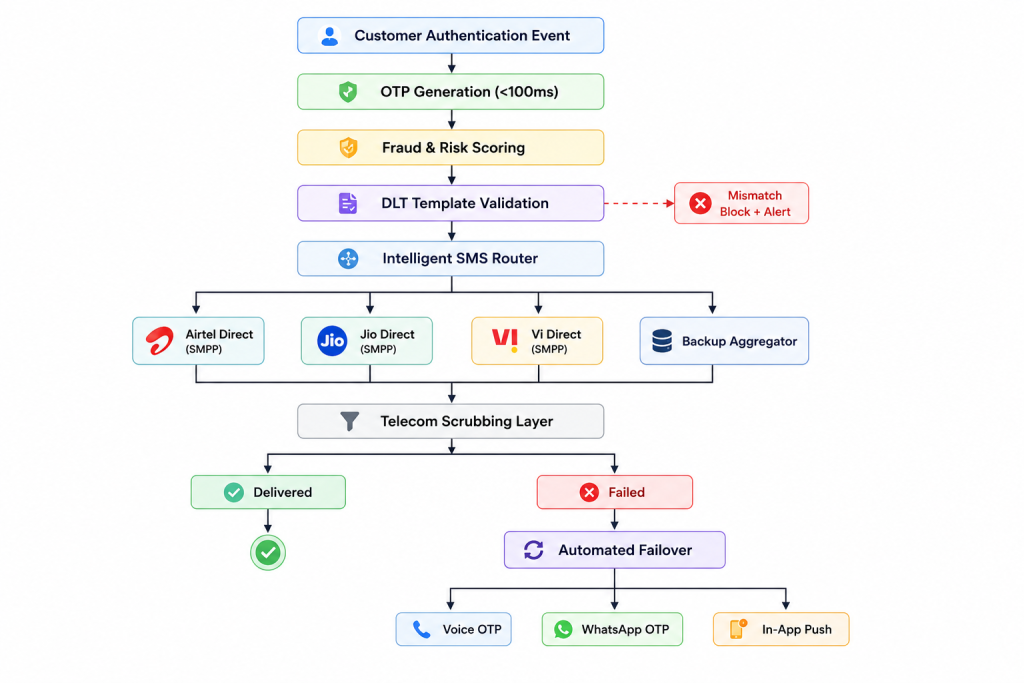
Route mismatch is the silent killer. Banking OTPs must travel transactional SMS routes — not promotional. Transactional routes deliver to DND subscribers 24/7. Promotional routes don’t. Routing OTPs down the wrong pipe means systematic delivery failure for a large slice of your customer base, with no error signal on your end.

DLT is a governance problem, not a setup task. TRAI mandates that every banking OTP pass through DLT-registered infrastructure — entity, sender header, template, variables, all of it pre-approved. A single word change in an OTP message that doesn’t match the registered template gets silently blocked at the telecom scrubbing layer. No delivery. No alert. Just a customer who never got their OTP.

Most banks set up DLT once and forget it. Template drift — a copy edit, a compliance update, a product rename — kills delivery at scale before anyone notices.

How Banks Actually Route OTPs

Single-provider SMS is a liability. High-volume banks run intelligent routing engines that dynamically select paths by operator, region, real-time latency, and historical success rates — direct SMPP to Airtel for one segment, Jio for another, backup aggregator for congestion scenarios.

When SMS fails beyond SLA thresholds, failover kicks in automatically:

Multi-channel redundancy isn’t optional anymore. Under RBI’s 2026 framework, authentication failure that leads to customer loss is the issuer’s liability. Your failover architecture is now a compliance control, not just an engineering nicety.

The Congestion Problem Nobody Plans For

Salary day. IPL finals. Festive sales. OTP volume spikes, telecom networks congest, and delivery times jump from milliseconds to seconds. Banks without congestion-aware routing absorb this passively — and their transaction success rates show it.

In January 2026, UPI processed 21.7 billion transactions in a single month. The daily average was 698 million transactions. Peak-day spikes above that baseline are predictable. The calendar doesn’t change. Plan the infrastructure accordingly.

The Shift Already Underway

The 2026 RBI directions are an explicit signal: India’s authentication future is not SMS-first. Device binding, silent network authentication, biometrics, in-app push — these are now formally recognised authentication factors, not workarounds.

For banks, this creates a real architecture decision. Rebuilding OTP infrastructure for sub-3-second delivery while simultaneously standing up biometric and token-based authentication isn’t a future project anymore. The compliance deadline already passed.

SMS OTP will remain essential for UPI onboarding, device changes, and cross-device verification for the foreseeable future. But the banks winning on transaction success rates are the ones treating authentication as a full-stack infrastructure problem — not a messaging function with a failover switch.

The April 2026 framework didn’t change the goal. It just made the cost of ignoring it explicit

For BFSI, a delayed OTP doesn’t just break the payment flow — it breaks the customer contact window. Elision Technologies partners with BFSI institutions as a licensed VNO to ensure compliant, sub-second OTP delivery across every collection touchpoint, from first notice to final resolution. 

Loading

Why Banks Are Moving to WhatsApp-First Customer Communication Globally

WhatsApp Banking is transforming how financial institutions communicate with customers. Instead of relying on traditional channels like SMS, IVR, emails, and branch visits, banks and NBFCs are now enabling customer interactions directly through WhatsApp for support, KYC, payments, reminders, onboarding, and authentication.

As customer expectations shift toward instant and conversational experiences, WhatsApp-led communication is becoming a key part of digital banking strategies in India.

With massive WhatsApp adoption across urban and rural India, financial institutions now have the opportunity to create more accessible, scalable, and customer-friendly banking experiences.

Why WhatsApp is the new front door for banking

Banks have traditionally depended on multiple communication channels — SMS for OTPs, calls for customer support, branches for KYC, and emails for updates. But for customers, this often means switching between platforms, repeating information, and dealing with slow or disconnected experiences.

WhatsApp is changing that.

With more than 500 million users in India and extremely high engagement rates, WhatsApp has become the platform customers already use every day. Instead of asking users to move across apps, websites, calls, and emails, banks can now deliver support, authentication, KYC, reminders, and service journeys within a single conversation.

For banks and financial institutions, this means:

  • Faster customer communication
  • Better engagement rates
  • Reduced support workload
  • More seamless digital experiences

WhatsApp Banking is no longer just an additional support channel — it is becoming the primary digital touchpoint for modern banking communication.

Passive vs active WhatsApp banking: understanding the two modes

Passive (always-on) WhatsApp banking

Passive WhatsApp banking runs in the background without requiring the customer to initiate anything. The bank sends proactive, contextual messages — transaction alerts, EMI reminders, fraud warnings, statement delivery, and loan offers — directly to the customer’s WhatsApp. No app download. No login. No SMS that never arrives.

This mode mirrors how the best consumer brands communicate: timely, personal, and on the platform the customer already uses. For BFSI, it replaces the unreliable SMS layer with a delivery-guaranteed, read-receipt-enabled communication thread.

Active (passphrase) WhatsApp banking

Active WhatsApp banking places the customer in the driver’s seat. A customer sends a predefined passphrase — ‘BAL’ for balance, ‘STMT’ for statement, ‘BLOCK’ to stop a card — to the bank’s verified WhatsApp number. The system authenticates the request, validates the session, and responds within the encrypted chat thread.

More advanced implementations layer voice biometrics onto this model — removing PINs, passwords, and security questions entirely. The customer speaks a short phrase; the system matches the voiceprint in under 10 seconds; the transaction is authorised. No credential to steal. No question to forget.

How Traditional ways are replacing with Modern Technology

The SMS OTP model is broken. Delivery rates hover between 70-80%, telecom networks are unreliable during peak hours, and SIM-swap fraud has made SMS authentication a known vulnerability. The Reserve Bank of India has already signalled the need for stronger authentication frameworks.

WhatsApp authentication messages offer a direct replacement. Here is how the flow works:

  • Customer initiates a transaction on net banking or mobile app
  • Bank triggers a WhatsApp authentication message to the verified number
  • Customer confirms via a one-tap reply or passphrase within the encrypted chat
  • Session is authenticated — no OTP to copy, no SMS to wait for, no telecom dependency

For NRI customers in the UAE, USA, or anywhere globally, this is transformative. WhatsApp functions on Wi-Fi and data — no roaming dependency, no international SMS failure. A customer in Dubai can authenticate a NEFT transfer to India as seamlessly as a customer sitting in Mumbai.

Conventional banking vs WhatsApp banking

Parameter Conventional Banking WhatsApp Banking
Customer authentication SMS OTP (delays, delivery failures) Passphrase on WhatsApp (instant, encrypted)
KYC process Branch visit or email PDFs, 3-5 days Document collection on WhatsApp, same day
Contact centre Call queues, high abandon rate WhatsApp chat, 77% first-contact resolution
OTP delivery rate ~70-80% (telecom dependent) ~98% (internet-based, global)
NRI / global access SMS fails on roaming WhatsApp works everywhere
Compliance trail Fragmented — call recordings, emails Single searchable chat thread
Cost per interaction High (agent + infrastructure) Low (automated + async)
Customer experience Reactive, channel-hopping Proactive, always-on messaging

Ready to define WhatsApp banking for your institution?

Elision is the Indian CCaaS provider building WhatsApp-first communication infrastructure for BFSI integrating with your CRM.

Whether you are a PSU bank looking for Modern Business Communications, a private bank scaling contact centre efficiency, or a fintech targeting the NRI corridor — the architecture is ready.

Talk to Elision Team — India · UAE · USA · Global

© Elision Technologies | WhatsApp Banking | BFSI

Loading

How Leading Indian Banks Are Outperforming 2026 Contact Center Benchmarks

In today’s banking environment, customer experience has evolved from a support function into a core business differentiator. Yet, across the BFSI sector, leadership teams continue to grapple with the same fundamental questions:

  • “Is our Average Handle Time competitive?”
  • “Is 68% FCR good enough — or are we leaving customer loyalty on the table?”
  • “What CSAT score puts us in the top quartile?”

The difference between an average and a high-performing contact center lies not in intuition, but in how effectively these questions are answered through data. Benchmarking, when grounded in sector-specific realities, provides the clarity needed to move from reactive operations to strategic optimization.

Why Benchmarking Matters More Than Ever in Indian BFSI

The Indian BFSI landscape is undergoing rapid transformation, driven by digital-first customers, real-time financial ecosystems, and increasing regulatory complexity. Customers now expect instant, seamless, and personalized support across channels, whether they are raising a fraud concern, completing KYC verification, or inquiring about loan services.

Despite this shift, many contact centers continue to rely on generic or outdated benchmarks that fail to capture the nuances of BFSI operations.

Global benchmarks don’t account for:

    • India-specific customer behavior and language diversity
    • The high volume of multilingual call interactions
    • The complexity of regulatory and KYC-related queries
    • Multi-channel expectations from a mobile-first population

Without relevant benchmarks, performance measurement becomes misleading—and improvement efforts often miss the mark.

The 2026 BFSI Contact Center Benchmarks at a Glance

Here’s what the data from 200+ Indian BFSI institutions tells us:

KPI Industry Average Top Quartile
Average Handle Time (AHT) 5.5–7 min 4–5 min
First Call Resolution (FCR) 70–75% 80%+
CSAT Score 75–80/100 85–90/100
WhatsApp / Messaging Deflection* ~20–30% 35–40%+

Let’s break down what these benchmarks mean — and how your contact center can move from average to top-quartile.

1. Average Handle Time (AHT): Speed Without Sacrifice

In BFSI contact centers, Average Handle Time reflects the total lifecycle of an interaction—from initial conversation to post-call documentation. Given the complexity of banking queries, AHT is influenced by multiple factors, including system accessibility, agent preparedness, and process efficiency.

The gap between the industry average and the top quartile is nearly 2-3 minutes per interaction. Scale that across thousands of daily interactions, and you’re looking at millions of rupees in staffing cost inefficiency.

What’s driving high AHT in Indian banking contact centers?

    • Lack of a unified agent desktop (toggling between multiple systems)
    • Poor knowledge base access during live calls
    • Manual after-call documentation (ACW dragging on)
    • Inadequate call routing sending customers to the wrong agent

How top-quartile Indian banks are reducing AHT:

✅ Deploying AI-powered agent assist tools that surface answers in real time

✅ Using smart IVR and intent-based routing to match customers to the right agent

✅ Integrating CRM with telephony for instant customer context

✅ Automating after-call work with AI call summaries

2. First Call Resolution (FCR): The Most Valuable Metric in Your Dashboard

FCR is arguably the single most impactful KPI in a banking contact center. When a customer resolves their issue in one call, they’re more satisfied, less likely to churn, and won’t flood your queue with repeat calls.

Across the industry, FCR typically ranges between 70–75%, while top-performing institutions consistently achieve 80% or higher. If your FCR is below this range, the impact is immediate—more repeat calls, higher operational costs, and declining customer trust.

Root causes of low FCR in Indian BFSI:

    • Agents lacking authority to resolve certain issues (constant escalations)
    • Poor knowledge management — agents can’t find answers fast enough
    • Disconnected systems preventing a single view of the customer
    • High transfer rates between departments

What moves FCR from 74% to 82%?

✅ Empowering front-line agents with clear resolution authority

✅ Building dynamic, searchable knowledge bases

✅ Using AI conversation intelligence to identify why calls repeat

✅ Tracking FCR by intent (loan queries, fraud calls, account issues) — not just center-wide

Key Insight: Top-quartile Indian banks track FCR by call intent category, not as a single aggregate number. This granularity reveals exactly where resolution is breaking down.

3. CSAT Score: The North Star of Customer Experience

CSAT (Customer Satisfaction Score) is your customers voting on how well you served them. An 11-point gap between the industry average and top-quartile performers in Indian banking is enormous — and it translates directly into customer retention, NPS, and lifetime value.

Industry averages typically fall in the 75–80 range, while top-quartile performers consistently achieve 85–90+.

A gap of even 8–10 points in CSAT can significantly impact customer loyalty, especially in a market where switching between financial providers is increasingly frictionless.

What CSAT measures beyond a score:

    • Quality of agent interactions
    • Speed and ease of resolution
    • Emotional experience (was the customer treated with empathy?)

How top Indian banks are pushing CSAT to 80+:

✅ Continuous quality monitoring with AI-based call analysis

✅ Regular agent coaching tied directly to post-call survey feedback

✅ Proactive outreach — resolving issues before customers need to call

✅ Multilingual support (Hindi, Tamil, Kannada, Bengali, Marathi) handled natively

4. WhatsApp Deflection: The Benchmark That’s Changing BFSI

This one is uniquely Indian — and it’s the benchmark most BFSI leaders aren’t tracking yet.

WhatsApp is now a primary customer service channel for Indian banking customers. Top-quartile BFSI institutions are deflecting 41% of voice interactions to WhatsApp-based automated or agent-assisted resolution — dramatically reducing cost per contact while improving customer convenience.

What this means for your contact center:

    • Lower inbound call volume = better service levels for complex calls
    • 24/7 query resolution without full staffing
    • Reduced AHT pressure on voice agents
    • Higher CSAT for customers who prefer async, text-based resolution

For BFSI organizations, messaging is no longer an optional add-on. It is becoming a core component of modern customer engagement.

From Benchmarking to Transformation

Across all these metrics, a clear pattern emerges: top-performing BFSI contact centers are those that combine data-driven decision-making with technology-led execution. AI-powered tools, intelligent routing, automated workflows, and omnichannel capabilities are no longer differentiators—they are becoming foundational.

Ultimately, benchmarking should not be viewed as a reporting exercise but as a catalyst for transformation. High AHT points to workflow inefficiencies, low FCR highlights gaps in resolution capability, and moderate CSAT indicates experience risks. Each metric tells a story—and together, they provide a roadmap for improvement.

The 2026 Performance Matrix: Where Does Your Contact Center Stand?

Performance Band AHT FCR CSAT
🔴 Below Average > 7–8 min < 65% < 70
🟡 Industry Average 5.5–7 min 70–75% 75–80
🟢 Top Quartile < 5 min > 80% > 85

Industry benchmark data from leading CX platforms.

The Gap Isn’t Just Measured. It’s Already Being Closed.

The shift is already happening.

Leading banks and financial institutions are not waiting to “analyze more data”—they are actively deploying:

  • AI-powered agent assistance to reduce handling time
  • Intelligent routing to improve first-call resolution
  • Automated workflows to eliminate manual effort
  • WhatsApp and messaging channels to deflect high-volume queries

Every month of delay widens the gap between industry average and top-quartile performance.

Don’t Compete with Old Methods

If your current setup is still dependent on manual workflows, fragmented systems, or voice-heavy support, you’re not just facing inefficiencies—you’re operating at a structural disadvantage.

Modern BFSI contact centers are being built on automation-first, omnichannel, and AI-led architectures designed for scale, speed, and customer convenience.

Move Faster. Serve Smarter. Stay Ahead.

The opportunity is not just to match industry benchmarks—but to leapfrog them with the right technology foundation.

👉 Deploy AI-powered contact center capabilities tailored for BFSI
👉 Reduce AHT, improve FCR, and elevate customer experience at scale
👉 Enable seamless voice + WhatsApp + omnichannel engagement

Because in 2026, the leaders won’t be the ones measuring performance—
they’ll be the ones already operating at the next level.

Talk to an ElisionTec consultant for a free Demo.

Loading

Here’s your RBI & TRAI Compliance Guide 2026: Cloud Telephony for BFSI in India

India’s banking, financial services, and insurance (BFSI) sector is in the middle of a massive digital shift. From neo-banks to digital lending platforms, every player is racing to deliver faster, smarter customer experiences.

Your bank just made 10,000 customer calls today.

How many of them were compliant?

If your contact centre is still dialling from standard 10-digit numbers — without DLT registration, without 1600-series routing, without verified caller IDs — the answer is zero. And the consequences are no longer just regulatory warnings. They are call blocks, number suspensions, and penalties that land on the boardroom table.

India’s BFSI sector is at an inflection point. The Reserve Bank of India has tightened its cybersecurity framework. TRAI has issued a landmark mandate that fundamentally changes how financial institutions make voice calls. And the window to comply is closing fast.

This guide breaks down exactly what has changed, why it matters, and how compliant cloud telephony in India becomes your institution’s strongest operational asset in 2026.


What Every BFSI Leader Must Know Right Now

Before diving deep, here’s the compliance snapshot your team needs on the wall:

  • 1600 series numbers are now mandatory for all BFSI service and transactional voice calls
  • Standard mobile numbers are no longer permitted for customer outreach by financial institutions
  • RBI mandates Zero Trust Architecture and India-only data storage across all cloud platforms
  • TRAI requires DLT registration and verified consent before every automated call
  • Non-compliant calls are automatically blocked — not reviewed, not warned about — blocked
  • Compliant cloud telephony automates all of this, so your team focuses on customers, not compliance

If even one of these points is news to you, keep reading.


Cloud Telephony for the Financial Institutions

Cloud telephony is the replacement of physical phone infrastructure with a fully managed, cloud-hosted voice communication system. No on-premise hardware. No tangled PBX systems. Just intelligent, scalable, and — crucially — auditable communication delivered over the cloud.

For BFSI institutions, it isn’t a technology upgrade. It’s the operational backbone behind every customer interaction:

  • Customer support — Smart IVR systems and intelligent call routing that resolve queries faster
  • Collections & recovery — Automated outbound dialling with fully compliant, timestamped recordings
  • KYC & verification — Voice OTP delivery and video KYC call management aligned with RBI guidelines
  • Loan processing — Real-time click-to-call connectivity between agents and applicants

These aren’t experimental workflows. They are daily, mission-critical operations running at millions of calls per month across India’s financial sector.

And every single one of them is now subject to strict regulatory governance.


Why Compliance is No Longer Optional for BFSI Communication

Let’s be direct about what’s at stake.

A single non-compliant calling campaign doesn’t just attract a fine. It can shut down your entire outbound communication channel — blocking OTPs, transaction alerts, and customer service calls simultaneously. In the BFSI sector, that’s not an inconvenience. That’s a crisis.

Here’s what non-compliance actually costs:

  • Monetary penalties from RBI and TRAI that scale with the severity and frequency of violations
  • Customer data breaches that trigger CERT-In reporting obligations within six hours
  • Brand trust collapse — in a sector where reputation is built over decades and destroyed overnight
  • Intensified regulatory audits following any flagged violation
  • Complete communication blackout — OTPs, alerts, and support calls all blocked simultaneously

The financial and operational cost of non-compliance far outweighs the investment in compliant infrastructure. The math is simple. The decision should be too.


RBI Guidelines for Cloud Telephony in 2026

The Reserve Bank of India’s cybersecurity and data governance frameworks have moved from recommendations to enforceable mandates. Here’s what matters most for cloud telephony:

Data Localisation — India First, Always

All customer data — call recordings, voice logs, OTPs, payment credentials, and authentication data — must be stored on servers physically located within India. If any processing occurs on foreign infrastructure, that data must be deleted abroad and stored in India within 24 hours.

This isn’t a guideline. It’s a hard rule with precedent-backed enforcement.

Zero Trust Cybersecurity Architecture

RBI’s 2026 framework mandates Zero Trust Architecture across all digital infrastructure. For cloud telephony platforms, this means:

  • Identity verification on every access request — no implicit trust, ever
  • End-to-end encryption for all voice communications
  • Micro-segmentation to contain any potential breach
  • AI-driven anomaly detection with real-time alerting

Call Recording, Retention & Audit Readiness

All recordings connected to financial transactions, collections, or customer disputes must be retained for prescribed periods and made immediately available for regulatory inspection. Ad hoc extraction won’t cut it — audit-readiness must be built into the system architecture.

KYC & Voice Verification Compliance

Every voice OTP, video KYC session, and phone-based verification must align with RBI’s evolving digital KYC framework — complete with tamper-proof, immutable audit trails for every interaction.


TRAI Regulations: The Compliance Layer Your Calls Travel Through

While RBI governs your financial data and security practices, TRAI governs every call and message that leaves your contact centre. These two regulatory frameworks aren’t separate — they are layered, and both must be satisfied simultaneously.

DLT Registration — No Exceptions

Every message template, sender ID, and communication header used by your institution must be registered on TRAI’s Distributed Ledger Technology platform. Unregistered communications are treated as spam — and blocked automatically.

Consent Management — Documented and Verifiable

Explicit, informed customer consent must be captured, logged, and verified before every automated or promotional call. A digital consent registry pilot — backed by blockchain-based tracking — is already underway with select banks.

Telemarketer Registration — Non-Negotiable

Every BFSI entity making outbound commercial calls must be registered as a telemarketer with TRAI-empanelled operators. Operating outside this registration is a direct compliance violation.

Caller ID & Number Masking

Caller IDs must accurately represent your registered institution. Agent and customer numbers must be masked where required. Misrepresentation of caller identity carries immediate penalties.


The TRAI 1600 Series Mandate: The Biggest Shift in BFSI Communication in Years

This is the most important regulatory development for BFSI voice communication in 2026 — and many institutions are still unprepared.

TRAI issued a landmark direction that permanently changes how regulated financial entities make voice calls in India.

The mandate is clear: All BFSI institutions must migrate from standard numbers to the dedicated 1600 numbering series for all service and transactional voice calls.

Understanding India’s Telephony Number Framework

Number Series Assigned Purpose Who Uses It
140 Promotional & marketing calls Sales campaigns, offers
160 Transactional SMS communications Alerts, notifications
1600 All BFSI voice calls — mandatory Banks, NBFCs, Insurers, AMCs


Why TRAI Mandated the 1600 Series

India has seen a dramatic rise in financial fraud conducted through spoofed calls mimicking banks and insurers. The 1600 series solves this at a systemic level:

  • Customers can instantly verify that a call is from a legitimate, regulated financial institution
  • Answer rates improve significantly when callers are verified and recognized
  • Regulators gain supervisory access to monitor communication practices in real-time
  • Fraudulent callers cannot mimic the verified 1600 series — consumer protection by design

What Calls Must Use the 1600 Series

Every service or transactional voice communication — without exception:

  • Account notifications and transaction confirmations
  • Customer service and query resolution calls
  • Collections and recovery operations
  • Voice OTP and authentication calls
  • Policy servicing and insurance claim updates
  • Investment and portfolio communication

Non-negotiable rule: Cross-selling during any service call on 160 or 1600 series numbers is strictly prohibited. Violations trigger immediate regulatory action — no grace period.


What Happens If You Miss Compliance Deadlines

TRAI and RBI enforcement in 2026 operates with zero tolerance. Here’s the escalating consequence framework:

TRAI Penalties — Immediate and Automatic

  • All non-compliant calls automatically flagged and blocked as spam
  • 15-day telecom resource suspension — no outbound calls, no OTPs, no alerts
  • Repeat violations: Complete one-year disconnection and blacklisting from telecom networks

RBI Enforcement Actions

  • Significant monetary penalties scaling with violation severity and duration
  • Restrictions on new customer acquisition for data governance failures
  • Mandatory system audits by CERT-In empanelled auditors
  • Personal accountability for board directors and senior executives

The Business Reality Beyond Penalties

The most damaging consequence isn’t the fine. It’s the operational blackout. When your calling infrastructure is suspended:

  • Critical OTPs don’t reach customers completing transactions
  • Collections teams cannot make a single outbound call
  • Customer service queues overflow with no outbound resolution capability
  • Your institution appears unreliable precisely when customers need you most

This is recoverable — but painfully, slowly, and at enormous cost.


Key Compliance Challenges BFSI Institutions Face

Understanding the mandate is step one. Executing compliance across a large, complex institution is where most organisations struggle.

The most common obstacles:

  • Multi-vendor fragmentation — Separate vendors for IVR, diallers, SMS, and WhatsApp create dangerous compliance blind spots with no single source of truth
  • Legacy system integration — Core banking platforms built a decade ago weren’t designed to talk to modern cloud telephony infrastructure
  • Data silos and inconsistency — Encryption standards and storage practices vary wildly across disconnected platforms
  • Audit readiness gaps — Without centralised, timestamped logs, generating a compliance report for a regulatory inspection becomes a week-long emergency exercise
  • Migration timeline pressure — Moving to 1600 series while maintaining zero disruption to live customer operations requires careful orchestration


How Compliant Cloud Telephony Solves Every One of These Challenges

The right cloud telephony platform doesn’t just provide calling infrastructure. It operationalises compliance — making it automatic, auditable, and scalable.

Here’s how a purpose-built BFSI communication solution addresses each challenge:

  • India-hosted infrastructure — Data localisation compliance from the moment you go live
  • Native 1600 series activation — Seamless number allocation with full DLT integration built in
  • Omnichannel unified platform — Voice, SMS, and WhatsApp under one auditable system, eliminating multi-vendor risk
  • Automated consent management — DLT-integrated workflows that capture, log, and verify consent at scale
  • Real-time compliance dashboards — Live monitoring that surfaces anomalies before they become regulatory violations
  • AI-powered call quality analysis — 100% call coverage, not just random sampling — flagging missed disclosures, prohibited phrases, and consent gaps instantly
  • Redundant failover infrastructure — Hitless continuity with defined Recovery Time Objectives


Compliance Best Practices: Your 2026 Action Checklist

✔️ Migrate to 1600 series immediately

✔️ Choose a vendor with licensed VNO status directly from the Department of Telecommunications

✔️ Ensure all data is India-hosted — verify physical server locations, not just vendor claims

✔️ Consolidate vendors into a single compliant platform that unifies voice, SMS, and digital channels

✔️ Automate DLT registration and consent workflows — manual processes fail at scale

✔️ Conduct quarterly compliance audits with CERT-In empanelled auditors

✔️ Train every contact centre agent on TRAI’s cross-selling prohibition and consent rules

✔️ Appoint a Data Protection Officer as required under the DPDP Act 2023

✔️ ISO and PCI DSS certifications from your telephony vendor

✔️ Test disaster recovery plans with documented, board-approved RTOs and failover procedures


Why Leading BFSI Institutions Choose Elision Technologies

At Elision Technologies, compliance isn’t a feature added to a communication platform. It’s the architecture the platform is built on.

TRAI Compliant Indian Numbers Solutions

Go live on 1600-series compliant telephony in minutes, not weeks.

  • Instant 1600 series number allocation with native DLT integration
  • Verified caller IDs that customers recognise — boosting answer rates and trust
  • Fully India-hosted infrastructure meeting every RBI data localisation requirement
  • Zero infrastructure burden — we handle telecom complexity while you serve customers

DialShree — Enterprise Contact Centre with Built-In Compliance

AI-powered quality management meets regulatory compliance automation:

  • 100% call quality coverage — every call scored in real-time, not random samples
  • Automated compliance flagging — missed disclosures, prohibited cross-selling, and consent gaps flagged instantly
  • Complete audit trails ready for RBI, TRAI, IRDAI, SEBI, and PFRDA inspections
  • Predictive dialling— intelligent outbound that respects customer preferences by default
  • Multilingual voice bots serving India’s diverse customer base with consistent compliance across languages


Conclusion: The 1600 Series Isn’t Just a Compliance Requirement — It’s a Trust Signal

The TRAI mandate and RBI frameworks aren’t designed to make your operations harder. They’re designed to make India’s financial communication ecosystem safer, more trustworthy, and more accountable.

Institutions that migrate early, build compliant infrastructure, and adopt purpose-built cloud telephony will gain more than regulatory clearance. They’ll gain:

  • Higher customer answer rates from verified, trusted caller identities
  • Deeper customer trust through transparent, regulated communication
  • Operational efficiency from automated compliance and AI-powered quality management
  • Protection from fraud exposure — both your institution’s and your customers’
  • Audit confidence — walk into any regulatory inspection fully prepared

The deadlines are real. The enforcement is live. And the technology to meet every requirement — without disrupting your operations — already exists.

The only question is whether your institution moves now, or waits for a blocked call to force the issue.


Make Your Communication Infrastructure Compliance-Ready Today

Your customers deserve verified calls. Your institution deserves protected infrastructure. Your compliance team deserves a platform that makes their job easier — not harder.

👉 Book a Live Personalised Demo with Elision Technologies

See 1600-series activation live. Watch AI compliance monitoring score a real call. Get a customised migration roadmap built around your institution’s exact deadlines and infrastructure.

No generic presentations. No sales scripts. Just the solution — working live, for your use case.

📩 Visit www.elisiontec.com or contact our BFSI compliance team today.

Your customers deserve verified communication. Your institution deserves compliant infrastructure.

Loading

How Smarter AI Automation Is Transforming NBFC Recovery Processes

Debt collection in India is getting harder—not easier.
Borrowers are increasingly difficult to reach. Spam tagging reduces pickup rates. Linguistic diversity across states lowers right-party connect (RPC). Regulatory expectations are tightening. And manual, agent-heavy processes continue to stretch recovery timelines far beyond what is operationally acceptable.
This guide explains how banks, NBFCs, and fintech lenders can modernize collections using AI voicebots, TTS reminders, omnichannel automation, speech analytics, and automated PTP tracking—to improve RPC, reduce cost per contact, and scale recoveries without scaling headcount.

Why Traditional NBFC Collection Models Are Breaking Down

A typical manual workflow follows a predictable—and costly—pattern: an agent dials a borrower, there’s no answer, the agent moves on, and follow-up happens later (sometimes too late to prevent bucket aging).
Multiply this across thousands of accounts daily and inefficiencies compound quickly:

  • Repeated dialing of spam-tagged numbers and low-connect series
  • Outreach in non-preferred languages, reducing engagement
  • No automated fallback when one channel fails
  • Missed Promise-to-Pay (PTP) commitments due to manual tracking
  • Poor digital-to-field coordination and fragmented borrower context
  • Limited QA visibility (random sampling misses systemic issues)
  • Weak auditability around script adherence and compliance language

In a country defined by linguistic diversity and rising digital awareness, single-channel, agent-dependent collections are no longer sufficient. Collections must evolve from repetitive dialing to intelligent orchestration.

What a Modern, AI-Powered Collection Stack Looks Like

Leading BFSI organizations are deploying systems that unify automation, multilingual communication, predictive outreach, and real-time analytics into one scalable workflow. Here’s what a future-ready collection department looks like in practice.
How the AI Collections Workflow Runs (Example)

  1. Pre-due / Due day: TTS reminder call + SMS with payment link
  2. No pickup: SMS/WhatsApp (if enabled) triggers automatically
  3. No action: Multilingual voicebot attempts with caller ID rotation
  4. PTP captured: System logs PTP + schedules follow-up before deadline
  5. Broken PTP: Auto-escalation to agent queue or field workflow
  6. Paid: Paid-case suppression removes account from calling lists instantly

    This is the shift from “dial more” to recover smarter.

1) AI Text-to-Speech (TTS) Reminders: Scale Early-Bucket Outreach Without Headcount

AI-driven TTS delivers personalized EMI reminders using natural-sounding voice—without live agent involvement. Campaigns can run beyond business hours (where permitted) and scale across large portfolios.
Messages can be personalized with variables like:

  • Borrower name
  • Amount due / overdue amount
  • Due date
  • Payment link or next step

This reduces agent load in early-bucket/soft collections, freeing human teams for negotiation-heavy cases where empathy and judgement matter.

2. Multilingual AI Voicebots: Improve RPC by Speaking the Borrower’s Language

India’s linguistic diversity isn’t a “nice-to-have”—it’s a structural requirement for high RPC. A borrower in Tamil Nadu called in Hindi is less likely to engage, regardless of attempt volume.
Modern voicebots support 10+ Indian languages (e.g., Hindi, Tamil, Telugu, Marathi, Bengali, Kannada) and can:

  • Confirm identity and right-party connect
  • Explain dues and next steps clearly
  • Capture intent (pay now, pay later, dispute, call back)
  • Log outcomes and trigger the next best action

Better communication directly improves RPC, responsiveness, and payment behavior.

3. Omnichannel Outreach: If One Channel Fails, Another Activates

A single call attempt is not a strategy. Modern platforms orchestrate voice + SMS + email + WhatsApp (optional) based on borrower behavior.
Example triggers:

  • Missed call → SMS with payment link and due details
  • No click → follow-up voicebot call
  • Dispute intent → route to trained agent queue
  • Payment confirmed → auto stop further communication

This reduces leakage and increases conversions without manual supervision.

4. Alternate Number Dialing + Caller ID Rotation: Reduce Impact of Spam Tagging

Relying on a single borrower number (or a single outbound caller ID) is a major blind spot.
Modern systems support:

  • Alternate number dialing: attempt secondary/tertiary borrower numbers automatically
  • Caller ID rotation: rotate outbound caller IDs to improve connect probability and reduce overexposure of one number

The platform can escalate connectivity logically instead of repeating the same failed attempt pattern.

5. Speech Analytics: Move from Random QA Sampling to 100% Oversight

Most QA today is reactive and incomplete—supervisors manually review a tiny fraction of calls. That approach misses compliance risks, coaching opportunities, and systemic issues spread across thousands of interactions.
Speech analytics changes this by analyzing every conversation to:

  • Detect sentiment and escalation signals
  • Flag risky language patterns and non-compliant phrases
  • Track script adherence
  • Identify repeat objections and payment blockers
  • Generate agent and campaign-level performance insights

QA becomes structured, data-backed, and auditable—not subjective and partial.

6. Smart PTP Tracking + Paid-Case Suppression: Stop Leakage and Wasted Calling

Promise-to-Pay commitments are valuable—yet manual tracking causes missed follow-ups and lost recovery windows.
AI workflows can:

  • Log every PTP automatically
  • Schedule reminders and follow-ups before deadline
  • Escalate broken PTP immediately
  • Suppress paid cases as soon as payments are confirmed

This reduces wasted dialing and avoids unnecessary borrower friction.

7. Unified Digital + Field Collections: One Source of Truth

Collections don’t end at digital outreach. Field agents are critical in later-stage recoveries—but handoffs often break due to poor context sharing.
A modern platform enables field teams with:

  • Borrower interaction history (calls, SMS, voicebot outcomes)
  • PTP dates and dispute notes
  • Visit schedules and case priority
  • Consistent updates back into one system

This eliminates manual coordination and creates a single, reliable operational view.

Results: What NBFCs Commonly Achieve with AI Collections Automation

Outcomes vary by portfolio, segment, and contactability, but organizations typically report improvements such as:

  • Higher early-bucket coverage (often 2–3x outreach capacity)

  • Lower cost per contact (commonly 40–65% reduction)
  • Improved RPC (often meaningful uplift, especially via language + orchestration)
  • Faster collection turnaround time (TAT), often reducing follow-up delays by days
  • Reduced compliance risk with consistent scripts + analytics-based oversight
  • Easier scalability during peak cycles without operational chaos

For large, geographically distributed portfolios, scalability is not a feature—it’s the core value.

Compliance & Trust: The Foundation of Sustainable Outreach

In India’s regulatory environment, every borrower interaction must be designed for trust, auditability, and compliance.

Key principles:

  • Use approved templates/scripts and consistent disclosures
  • Maintain audit trails for interactions and outcomes
  • Monitor language and escalation triggers
  • Ensure consent and governance processes are followed

Note: Number series usage and outreach guidelines can depend on your telecom setup and evolving regulations. Always validate numbering, templates, and consent requirements with your telecom/provider and compliance team.

Trust and compliance don’t compete—they reinforce each other. Higher credibility improves pickup rates, and pickup rates drive recovery.

The Cost of Waiting Compounds Every Cycle

Every manual cycle compounds inefficiency. Every delayed follow-up reduces recovery probability. Every missed contact accelerates bucket aging.
Automation doesn’t replace collection agents—it amplifies them. It enables a leaner, better-orchestrated team to achieve outcomes a larger manual team often cannot.
The question is not whether AI belongs in collections.

The question is how long you can afford to operate without it.

Let connect for more AI Driven solution!

Loading

The Future Of BFSI Customer Experience Lies In Omnichannel Platforms

How Multi-Channel Unification is Reshaping Contact Center Excellence

Picture this: A customer calls your bank’s helpline about a suspicious transaction. Then follows up on WhatsApp. Sends an email with screenshots. And finally tweets about the delayed response.
Your agents are scrambling across four different dashboards, trying to piece together the conversation. Context is lost. Compliance risks multiply. The customer? Already considering switching banks.

Sound familiar?

The Real Challenge for BFSI Isn’t Technology—It’s Fragmentation

Today’s banking and financial services contact centers aren’t struggling because they lack tools. In fact, most have too many.
The average BFSI contact center juggles:

  • Voice calling systems for account queries
  • Secure email platforms for document sharing
  • Social media monitoring for reputation management
  • Live chat for loan applications
  • SMS gateways for OTPs and alerts
  • WhatsApp Business for transaction updates
  • Multiple CRM and core banking integrations

Each channel works. But they don’t work together.
And in an industry where trust, speed, and compliance are non-negotiable—that’s a critical vulnerability.

What Is Multi-Channel Unification?

Multi-channel unification means bringing all your customer communication channels—voice, email, chat, social media, SMS, WhatsApp—into a single, intelligent, and secure platform.
It’s not just about having all channels available. It’s about having them connected with context and compliance.

When a customer reaches out on any channel:

  • Agents see the complete conversation history with full audit trails
  • Context carries over seamlessly without compromising security
  • Routing happens intelligently based on expertise, query type, and regulatory requirements
  • Reporting gives you a unified view of performance and compliance metrics

Think of it as giving your BFSI contact center a single, secure nervous system instead of multiple, disconnected organs.

Why BFSI Leaders Are Making the Shift

1. Customers Demand Banking-Grade Experiences Across All Channels

Today’s banking customers don’t think in channels—they think in urgency. They expect you to remember what they said on chat when they call about their credit card limit five minutes later.
In BFSI, where 78% of customers say they’d switch providers after a poor service experience, this isn’t optional—it’s survival.
A unified platform makes seamless, contextual service possible while maintaining the security standards your customers expect.

2. Agent Productivity Soars (While Compliance Stays Intact)

When agents aren’t toggling between six different systems to verify a customer’s identity or retrieve transaction history, they can focus on what matters: solving complex financial queries and building trust.
One leading private bank reported that after unifying their channels with Dialshree, their average handle time for loan inquiries dropped by 22%, while their compliance audit scores improved—because every interaction was logged in one centralized, secure system.

3. Operational Costs Drop Significantly

Managing multiple vendors in BFSI means:

  • Multiple security audits and compliance certifications
  • Redundant infrastructure costs
  • Complex disaster recovery planning across systems
  • Higher training and maintenance expenses

Unification simplifies your vendor ecosystem, reduces licensing costs, streamlines compliance management, and makes troubleshooting exponentially easier.

For insurance providers and NBFCs operating on tight margins, this translates directly to bottom-line impact.

4. Regulatory Compliance Becomes Manageable

When channels are siloed, so is your compliance data. Auditing customer interactions across phone, email, chat, and social media becomes a nightmare.
A unified platform gives you:

  • Centralized audit trails across all channels
  • Automated compliance monitoring and alerts
  • Easy retrieval during regulatory audits
  • Consistent data retention policies
  • Built-in encryption and security protocols

Whether it’s RBI guidelines, data localization requirements, or customer grievance redressal mandates—unified platforms make compliance systematic rather than chaotic.

5. Fraud Detection and Security Improve

In BFSI, fraud attempts often span multiple channels. A phishing email followed by a spoofed call. A social media scam leading to fake website links.
When your channels are unified, pattern recognition becomes possible. Suspicious activities across touchpoints trigger immediate alerts, and your fraud prevention team has complete visibility.

6. Scaling During Peak Periods Becomes Simple

Whether it’s tax season for insurance claims, year-end for mutual fund investments, or festive season for loan applications—BFSI contact centers face extreme volume fluctuations.
Adding a new channel or scaling capacity shouldn’t require a 6-month integration project. With a unified platform, new channels plug in seamlessly, and capacity scales elastically based on demand.

Real-World Impact: A Banking Success Story

A mid-sized private bank was operating separate systems for phone banking, email support, and social media management. During a product launch, customers would call about an application already submitted via email—but agents had no visibility. Complaints escalated to social media, and the bank’s NPS score dropped.

After implementing Dialshree’s unified contact center solution:

  • Customer satisfaction scores increased by 27% – Agents could see complete customer histories with proper authentication
  • First call resolution improved by 34% – No more “let me check another system and call you back”
  • Complaint resolution time reduced by 41% – Omnichannel tracking made escalation management seamless
  • Regulatory audit preparation time cut by 60% – All interaction data centralized with proper tagging
  • Cross-sell conversion improved by 19% – Agents could identify opportunities from complete customer journey visibility

The transformation wasn’t just operational—it was strategic, competitive, and compliance-positive.

The Technology Behind the Simplicity

Modern unified contact center platforms like Dialshree leverage:

Cloud-Native Architecture – Scalability and reliability without infrastructure headaches, with banking-grade security
AI-Powered Routing – Intelligent distribution based on skills, query complexity, customer value, and compliance requirements
Universal Queues – All channels feeding into smart, prioritized workflows with SLA management
Real-Time Analytics – Dashboards that update as conversations happen, with compliance and performance KPIs
Open APIs – Easy integration with core banking systems, CRM, loan management, insurance platforms, and payment gateways
Flexible Deployment – Whether you’re on-premise for data sovereignty, cloud for agility, or hybrid—the platform adapts to your regulatory and business needs
Built-in Security – End-to-end encryption, role-based access controls, PCI-DSS compliance, and data residency options

But here’s what matters most: The technology stays in the background. Your team experiences simplicity. Your customers experience consistency. Your auditors see compliance.

Unification Isn’t Just an Upgrade—It’s a Competitive Necessity

In an industry where customer experience is the primary differentiator and regulatory compliance is mandatory, fragmented systems are a liability you can’t afford.
Every second an agent spends switching systems is a second not spent resolving a loan query or preventing account fraud.
Every customer who has to repeat their issue across channels is a customer considering your competitor’s seamless digital banking experience.
The question isn’t whether to unify your contact center channels—it’s how quickly you can get there while maintaining the security and compliance standards BFSI demands.

Your Next Step

BFSI customer service excellence doesn’t require a complete overhaul. It requires the right foundation.
A foundation where every channel works together securely, every interaction has context and compliance, and every customer feels heard and protected.

Discover how Dialshree by Elision Technologies can unify your Banking contact center operations while maintaining banking-grade security and regulatory compliance.

Because in the end, your customers don’t care about your systems. They care about being understood, protected, and served efficiently. And that starts with giving your team the tools to make it happen—without compromising on security or compliance.


Ready to move from chaos to clarity while keeping compliance intact? Let’s talk about how unified contact center solutions can transform your BFSI customer operations.

Loading

TRAI 1600-Series Mandate for BFSI: Phased Deadlines Explained | DialShree

TRAI 1600-series mandate phased compliance deadlines for BFSI banks, NBFCs, and insurers
Local Preview — Not for Production

About this guide: maintained by Elision Technologies. Regulatory references are checked against TRAI’s November 19, 2025 direction (RBI/SEBI/PFRDA-regulated entities) and its December 16, 2025 companion direction (IRDAI-regulated insurers) on 1600-series numbering. Last reviewed: July 2026. Deadlines below are phased by entity type — confirm your specific category’s date directly with TRAI or your telecom service provider before relying on any date here for compliance purposes.

TRAI 1600-series mandate rules require all BFSI service and transactional voice calls in India to move from standard 10-digit numbers to a dedicated, TRAI-allocated 1600-series number, with compliance deadlines phased by entity type rather than a single universal date. Commercial banks face the earliest deadline (January 1, 2026); large NBFCs, payment banks, and small finance banks follow a month later; insurers, mutual funds, and AMCs have until February 15, 2026; and remaining NBFCs, co-operative banks, and regional rural banks have until March 1, with qualified stockbrokers completing adoption by March 15, 2026.

Getting this specific detail right matters: a bank and an NBFC reading generic “January 1 deadline” content could reasonably assume the same date applies to both, when it doesn’t. This guide is built around the actual phased structure, not a simplified single-date version.

What TRAI Actually Directed, and When

On November 19, 2025, TRAI issued a direction requiring RBI, SEBI, and PFRDA-regulated entities to migrate all service and transactional voice calls from standard 10-digit mobile numbers to the 1600-series format. A separate, related direction followed on December 16, 2025, extending the same requirement to IRDAI-regulated insurers on their own timeline.

  • Old format: standard 10-digit mobile numbers (e.g., 98XXX-XXXXX)
  • New format: dedicated 1600-series numbers (e.g., 1600-XXX-XXX)
  • Scope: service calls (customer support, query resolution), transactional calls (OTPs, payment confirmations, transaction alerts), and operational calls (EMI reminders, policy renewal notices, documentation requests)

The Actual Phased 1600-Series Deadlines, by Entity Type

Entity Type Compliance Deadline Governing Direction
Commercial banks January 1, 2026 TRAI direction, Nov 19, 2025
Large NBFCs, payment banks, small finance banks February 1, 2026 TRAI direction, Nov 19, 2025
Insurers, mutual funds, AMCs February 15, 2026 TRAI direction, Dec 16, 2025 (IRDAI-regulated)
Remaining NBFCs, co-operative banks, regional rural banks March 1, 2026 TRAI direction, Nov 19, 2025
Qualified stockbrokers March 15, 2026 TRAI direction, Nov 19, 2025

A call placed from a non-compliant number after your entity type’s specific deadline is a compliance gap on its own, independent of anything said on the call. Missing your own category’s date, even if it’s later than a competitor’s, carries the same enforcement exposure.

570+ Regulated entities that have adopted the 1600-series so far
3,000+ Individual 1600-series numbers already activated
5 Distinct entity categories, each with its own deadline
TRAI 1600-series mandate phased compliance deadlines by entity type A horizontal timeline showing five phased compliance deadlines for the TRAI 1600-series mandate: commercial banks January 1 2026, large NBFCs and payment banks February 1 2026, insurers and mutual funds February 15 2026, remaining NBFCs March 1 2026, and qualified stockbrokers March 15 2026. Jan 1, 2026 Commercial banks Feb 1, 2026 Large NBFCs, payment banks Feb 15, 2026 Insurers, mutual funds Mar 1, 2026 Remaining NBFCs Mar 15 Stock- brokers

Why TRAI Introduced the 1600-Series Requirement

Fraud prevention is the primary driver. Impersonation scams using ordinary mobile numbers to pose as bank or insurer representatives have driven real, measurable financial losses across India’s BFSI sector. A dedicated, verifiable number series gives customers a real signal to distinguish legitimate institutional contact from impersonation.

Regulatory traceability was difficult under the old system. RBI, SEBI, IRDAI, and PFRDA had limited ability to audit and monitor communications spread across thousands of individual 10-digit numbers. A centralized, DLT-registered numbering framework gives regulators a real audit trail.

Customer trust and answer rates are a real secondary benefit, not the primary driver. Industry observations following early rollouts have suggested meaningfully improved call pickup rates once customers learn to recognize the 1600-series prefix as a legitimate institutional number — though this varies by institution and customer base, and shouldn’t be treated as a guaranteed figure.

What a 1600-Series Migration Actually Involves

Step 1: Audit current number usage

  • How many numbers are currently used for service/transactional calling, across which departments and functions
  • Current call volume by number and by function
  • Which third-party vendors or outsourced call centers place calls on your behalf — their compliance responsibility passes through to you

Step 2: Calculate 1600-series number requirements

  • Whether separate numbers are needed per function (collections vs. customer service vs. renewals)
  • Whether regional/branch-level number allocation is needed

Step 3: Apply through a TRAI-authorized telecom provider

Not every provider is equipped to issue 1600-series numbers quickly — confirm authorization and BFSI-specific migration experience before committing. Typical documentation includes company registration, GSTIN, business PAN, authorized signatory KYC, and the relevant regulatory registration certificate (RBI/IRDAI/SEBI/PFRDA, as applicable).

Step 4: Technical integration and testing

PBX/IVR reconfiguration, CRM integration, call routing updates, and full testing before cutover — ideally with a buffer before your entity type’s actual deadline, not scheduled against it exactly.

Step 5: Customer and internal communication

Updated website and app contact information, customer notifications ahead of the change, and internal training so frontline teams can explain the new number format when asked.

Compliance Note

This guide describes the regulatory requirement and a general migration approach. It does not replace confirming your specific entity type’s deadline and documentation requirements directly with TRAI, your regulator, or your telecom service provider. Always validate before relying on any date or requirement listed here.

Where This Fits Into Your Broader Compliance Picture

1600-series migration is one piece of a larger BFSI compliance requirement set, not an isolated fix. If your outbound calling already needs to satisfy RBI’s Fair Practices Code or TRAI’s TCCCPR alongside this numbering change, addressing them together is more efficient than treating each as a separate project. DialShree’s Collection Module for NBFC and BFSI recovery and AI Voice Analysis capability are both built around the same real-time compliance monitoring principle this migration is part of — flagging risk signals as calls happen, not after the fact.

Confirm Your Entity Type’s Actual 1600-Series Deadline First

The single most common mistake in TRAI 1600-series mandate planning is assuming the January 1 date applies universally. It doesn’t. Confirm which category your institution falls into, and plan the migration timeline around that specific date rather than the earliest one you’ve seen referenced.

Planning your 1600-series migration alongside broader compliance needs?

Explore DialShree’s contact centre platform, or book a walkthrough covering compliance monitoring, collections, and renewal calling together.

Book a Demo

Sources & Regulatory References

This guide references the following primary regulatory sources. Regulations and directions are updated periodically — always check the regulator’s own site for the current version before relying on any specific requirement for compliance purposes.


Frequently Asked Questions

What is the TRAI 1600-series mandate?

TRAI’s 1600-series mandate requires BFSI entities to migrate service and transactional voice calls from standard 10-digit numbers to a dedicated, TRAI-allocated 1600-series number, with deadlines phased by entity type rather than a single universal date.

Is January 1, 2026 the deadline for all BFSI institutions?

No. January 1, 2026 applies specifically to commercial banks. Large NBFCs, payment banks, and small finance banks have until February 1, 2026; insurers, mutual funds, and AMCs until February 15, 2026; remaining NBFCs, co-operative banks, and regional rural banks until March 1, 2026; and qualified stockbrokers until March 15, 2026.

Does this apply to calls made by third-party vendors or outsourced call centers?

Yes. If a third-party vendor or outsourced call center places service or transactional calls on your institution’s behalf, that calling activity falls under your compliance responsibility for 1600-series adoption.

Can 1600-series numbers be used for promotional or marketing calls?

No. The 1600-series is designated specifically for service and transactional communication. Promotional or marketing use is not permitted on this number series.

What happens if an institution misses its specific deadline?

Calls placed from non-compliant numbers after an entity’s specific deadline risk being blocked or flagged, independent of call content. Confirm requirements directly with TRAI or your telecom provider, since enforcement specifics should be verified rather than assumed.


Loading

The Role of Pragmatic Solutions in Enhancing Banking Communication

Banking Communication Solutions

In today’s banking and finance landscape delivering top-notch customer service is no longer a luxury. It’s a component, of survival and advancement.

As the industry faces competition from fintech players and evolving customer demands traditional financial institutions are under pressure to enhance the overall client experience. Despite this urgency, many standing firms still grapple with outdated systems that hinder communication across various channels.

The implications are substantial. Studies indicate that subpar customer service leads to losses exceeding $75 billion annually with dissatisfied customers deterring approximately 15 others from engaging with a business.

Conversely, exceptional service translates to increased revenue and enhanced customer loyalty. In the realm of banking and finance quality service directly impacts customer acquisition, retention rates and overall trust.

To address these hurdles head-on industry leaders are increasingly turning towards customer engagement platforms driven by AI and machine learning technologies. When implemented thoughtfully these solutions facilitate responses, interactions across multiple channels personalized experiences tailored to individual preferences and ongoing refinements, for optimal performance.

However, merely adopting tech tools is insufficient. Companies must also adopt an approach centered on prioritizing customer needs at every touchpoint and interaction.

This article delves into the steps banks and financial institutions can take to enhance client communication in today’s demanding landscape. By implementing the strategy and platform they can provide services on a larger scale while improving efficiency and managing costs effectively.

To achieve this, leaders need to challenge outdated practices and prioritize customer approaches. Those financial institutions that embrace change will emerge as the frontrunners of tomorrow while those reluctant to adapt risk being left behind. The decision is crystal clear.

Obstacles, in Ensuring Exceptional Service

The task of delivering top-notch customer service has become increasingly complex for banks and financial entities. Modern customers expect seamless service round the clock and swift issue resolution. However outdated systems hinder agents from accessing customer profiles and transaction histories leading to disjointed experiences and dissatisfied clientele.

Key challenges confront banks and finance institutes:

Rising Customer Expectations

Customers demand tailored services across platforms expecting agents to recognize them individually and cater to their needs. Yet many banks struggle with dispersed data, across systems hindering a view of each customer.

Shifting Demographics

Millennials and Gen Z customers favor self-service options. Banks are being encouraged to provide customer service through channels such, as chat, social media, WhatsApp and SMS based on customer preferences.

Yet many banks have not fully embraced omnichannel interactions. Comprehensive omnichannel contact centre platforms may do a trick here, book a free demo now!

Challenges with Handling Volume

When call volumes peak customers get frustrated waiting on hold for periods. However, just hiring staff is not always a solution due to cost and inefficiency. Banks require systems of understanding customer needs and automating repetitive tasks. Tailored chatbot workflows can save phone bankers significant time, freeing them up for more productive activities.

Data Fragmentation

Customer information is often scattered across systems for banking services, loans, credit cards, etc. This fragmentation makes it hard for agents to grasp a picture of the customer relationship without switching between systems.

To a certain extent, having all the key and important client information readily available is crucial during live customer calls. To consistently provide notch personalized service banks need to reconsider their approach to engaging with customers and the technology they use.

Challenges Posed by Outdated Systems

Banks and financial institutions still rely on outdated legacy systems that are rigid and obsolete in today’s digital world;

Rigidity

Legacy systems typically run on traditional on-premises software that is not easily adaptable or integrable, with new communication channels and touchpoints. These systems were primarily designed for call centre operations.

Lack the flexibility needed for modern omnichannel support. The transition of a conventional platform is difficult, and advanced contact center solution needs of the time; advancement is not the only factor, ‘ready-to-use modules’ will be a differentiator in today’s time.

No Unified Conversation

Legacy systems do not support omnichannel operations, which hinders the ability to connect insights, from channels for a customer experience. Agents may struggle with understanding the context of conversation when interacting on platforms such as the web, mobile, chat and email, hence 360’s customer profile will help to drive conversation easily and quickly.

Let AI work its magic

Yet another constraint is the reliance on manual efforts for improved quality and service. In today’s time, it is not advisable to invest time in listening to recordings and providing training to your agents. These tasks can be automated, allowing them to be completed even without being physically present at the workplace.

As a result of these shortcomings legacy systems fall short of meeting the expectations of consumers who seek personalized service across multiple touchpoints. This ultimately impacts customer satisfaction levels.

Advantages of AI-Powered Platforms

AI-driven customer service platforms offer advantages compared to legacy systems in enhancing communication and comprehension, with clients. Here are some key benefits;

Voice and Text Analysis

Artificial intelligence can analyze both voice and text interactions either in time or, after a call. This analysis can reveal insights such as customer emotions, potential compliance issues, transcripts agent adherence to scripts and more. It uncovers data that can be used to enhance efficiency.

Chat Assistance

Smart chatbots are designed to handle common customer queries without the need for intervention. They offer round-the-clock availability and through learning using machine algorithms they improve their ability to understand questions and provide responses over time. Chatbots play a role in reducing customer wait times. Freeing up agents to focus on complex problems.

Understanding Customer Behavior

By processing amounts of customer data AI models can detect trends identify patterns and extract insights. This deep understanding of customer behavior helps in recognizing their needs pinpointing areas of friction in interactions and uncovering opportunities for enhancements.

Empowering Client Communication

AI-powered platforms elevate client communication by offering omnichannel support, and advanced analytics capabilities as automation features. This results in interactions, with customers that are efficient scalable and tailored to individual needs.

A global bank successfully enhanced client satisfaction through an AI-driven communication platform as part of its transformation efforts. They aimed to provide more convenient customer service to improve the client experience.

Despite facing challenges, in handling a volume of customer inquiries efficiently at their call centers they sought ways to overcome this issue. Long wait times frustrated clients and overwhelmed agents were issues they encountered.

To enhance self-service options the bank integrated an AI-powered platform with features such as blended calling and intelligent IVRs along with functionalities like SMS and voice broadcasting.

The outcomes were remarkable;

  • Achieved 100% system uptime
  • Improved loan debt collection by 82.31%
  • Boosted agent productivity by 79.26%

This case study highlights how one organization revamped its customer engagement and interaction significantly. There are success stories, in our portfolio that showcase the performance and high customer satisfaction achieved through DialShree – AI-Driven advanced platform.

Loading

Contact Us

Our experts can resolve your customer engagement issues

Book a free consultation with our expert and see why more than 25000 users across 50 countries trust Elision for their communication needs.
Contact Us