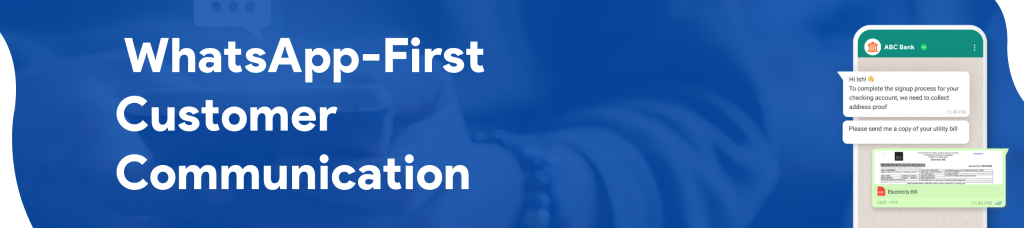
WhatsApp Banking is transforming how financial institutions communicate with customers. Instead of relying on traditional channels like SMS, IVR, emails, and branch visits, banks and NBFCs are now enabling customer interactions directly through WhatsApp for support, KYC, payments, reminders, onboarding, and authentication.
As customer expectations shift toward instant and conversational experiences, WhatsApp-led communication is becoming a key part of digital banking strategies in India.
With massive WhatsApp adoption across urban and rural India, financial institutions now have the opportunity to create more accessible, scalable, and customer-friendly banking experiences.
Why WhatsApp is the new front door for banking
Banks have traditionally depended on multiple communication channels — SMS for OTPs, calls for customer support, branches for KYC, and emails for updates. But for customers, this often means switching between platforms, repeating information, and dealing with slow or disconnected experiences.
WhatsApp is changing that.
With more than 500 million users in India and extremely high engagement rates, WhatsApp has become the platform customers already use every day. Instead of asking users to move across apps, websites, calls, and emails, banks can now deliver support, authentication, KYC, reminders, and service journeys within a single conversation.
For banks and financial institutions, this means:
Faster customer communication
Better engagement rates
Reduced support workload
More seamless digital experiences
WhatsApp Banking is no longer just an additional support channel — it is becoming the primary digital touchpoint for modern banking communication.
Passive vs active WhatsApp banking: understanding the two modes
Passive (always-on) WhatsApp banking
Passive WhatsApp banking runs in the background without requiring the customer to initiate anything. The bank sends proactive, contextual messages — transaction alerts, EMI reminders, fraud warnings, statement delivery, and loan offers — directly to the customer’s WhatsApp. No app download. No login. No SMS that never arrives.
This mode mirrors how the best consumer brands communicate: timely, personal, and on the platform the customer already uses. For BFSI, it replaces the unreliable SMS layer with a delivery-guaranteed, read-receipt-enabled communication thread.
Active (passphrase) WhatsApp banking
Active WhatsApp banking places the customer in the driver’s seat. A customer sends a predefined passphrase — ‘BAL’ for balance, ‘STMT’ for statement, ‘BLOCK’ to stop a card — to the bank’s verified WhatsApp number. The system authenticates the request, validates the session, and responds within the encrypted chat thread.
More advanced implementations layer voice biometrics onto this model — removing PINs, passwords, and security questions entirely. The customer speaks a short phrase; the system matches the voiceprint in under 10 seconds; the transaction is authorised. No credential to steal. No question to forget.
How Traditional ways are replacing with Modern Technology
The SMS OTP model is broken. Delivery rates hover between 70-80%, telecom networks are unreliable during peak hours, and SIM-swap fraud has made SMS authentication a known vulnerability. The Reserve Bank of India has already signalled the need for stronger authentication frameworks.
WhatsApp authentication messages offer a direct replacement. Here is how the flow works:
Customer initiates a transaction on net banking or mobile app
Bank triggers a WhatsApp authentication message to the verified number
Customer confirms via a one-tap reply or passphrase within the encrypted chat
Session is authenticated — no OTP to copy, no SMS to wait for, no telecom dependency
For NRI customers in the UAE, USA, or anywhere globally, this is transformative. WhatsApp functions on Wi-Fi and data — no roaming dependency, no international SMS failure. A customer in Dubai can authenticate a NEFT transfer to India as seamlessly as a customer sitting in Mumbai.
Conventional banking vs WhatsApp banking
Parameter
Conventional Banking
WhatsApp Banking
Customer authentication
SMS OTP (delays, delivery failures)
Passphrase on WhatsApp (instant, encrypted)
KYC process
Branch visit or email PDFs, 3-5 days
Document collection on WhatsApp, same day
Contact centre
Call queues, high abandon rate
WhatsApp chat, 77% first-contact resolution
OTP delivery rate
~70-80% (telecom dependent)
~98% (internet-based, global)
NRI / global access
SMS fails on roaming
WhatsApp works everywhere
Compliance trail
Fragmented — call recordings, emails
Single searchable chat thread
Cost per interaction
High (agent + infrastructure)
Low (automated + async)
Customer experience
Reactive, channel-hopping
Proactive, always-on messaging
Ready to define WhatsApp banking for your institution?
Elision is the Indian CCaaS provider building WhatsApp-first communication infrastructure for BFSI integrating with your CRM.
Whether you are a PSU bank looking for Modern Business Communications, a private bank scaling contact centre efficiency, or a fintech targeting the NRI corridor — the architecture is ready.
India’s banking sector is in the midst of an unprecedented fraud crisis. RBI data shows over ₹36,000 crore in bank frauds reported in FY 2024–25 alone, while cumulative losses over recent years run into tens of thousands of crores—raising serious concerns around security, compliance, and customer trust.
After 15+ years of working with banking contact centers across India, I’ve seen this landscape evolve dramatically. What once started as simple phishing has now become highly sophisticated, AI-driven fraud. Today’s fraudsters use SIM swap attacks, social engineering, spoofed caller IDs, and even deepfake voice technology to bypass traditional security measures.
The uncomfortable truth is this: OTPs, PINs, and security questions are no longer enough.
The Problem Banks Face Today
Fraud is faster than ever. A fraudster can access an account, navigate IVR systems, and execute unauthorized transactions in minutes. By the time fraud teams react, the damage is already done.
Call center agents—handling hundreds calls daily—are expected to identify threats in real time. Without intelligent systems, they rely on manual verification and instinct, both of which modern fraudsters easily manipulate.
To counter this, banks add more layers of authentication. But this leads to:
Longer wait times
Poor customer experience
Higher call abandonment
And still—fraud continues to rise.
The Shift: AI-Powered IVR Systems
Banks are moving beyond traditional “menu‑rotating” IVR and adopting AI‑powered IVR systems that act as an active fraud sensor in every customer interaction. These systems don’t just route calls—they detect, verify, and block fraud in real time, often before any transaction is executed.
Customer‑Facing Fraud Controls via IVR
Report suspicious transactions Banks embed dedicated IVR menu options so callers can quickly report unauthorized transactions or lost/stolen cards. This instantly triggers internal fraud workflows, enabling faster investigation and action.
Instant card/account freeze Customers can block a lost debit or credit card—or temporarily freeze an account—directly through IVR keypad inputs, significantly reducing the window of opportunity for fraudsters.
Two‑factor and voice‑based authentication AI‑powered IVR can combine PINs, one‑time passwords (SMS/email), and voice biometrics to verify the caller’s identity before allowing sensitive actions. This layered approach makes it much harder for impersonators or social‑engineering fraudsters to hijack accounts.
Bank‑Driven Fraud‑Mitigation Actions
Outbound fraud notifications When a suspicious transaction is detected, the bank can trigger an outbound IVR call to the customer to confirm the payment or issue a warning, with an option to speak to a live agent if needed.
Automated counter‑measures After repeated failed authentications or suspicious key‑press patterns, the IVR can automatically lock certain services, block further attempts, or escalate the call to the fraud team—ensuring rapid containment without waiting for manual review.
Taken together, these capabilities turn AI‑powered IVR from a simple self‑service channel into a real‑time, intelligent fraud‑control layer that reduces losses, improves response time, and enhances customer trust.
AI‑Powered IVR Supports Fraud Detection
Pattern‑based alerts Modern IVRs (often AI‑driven) continuously monitor call and transaction patterns, flagging unusual behavior such as multiple failed logins, rapid‑fire transfers, or atypical locations. When anomalies are detected, the system can trigger alerts or enforce extra verification steps automatically.
Real‑time risk scoring Each call is scored for risk based on factors like caller location, device, behavior, and timing. High‑risk calls are either escalated to fraud specialists or subjected to stricter authentication, while low‑risk calls move smoothly through self‑service.
Real Impact on BFSI Operations
Banks implementing AI-powered IVR are already seeing measurable results:
Up to 78% reduction in fraud attempts
Authentication time reduced from ~60 seconds to under 5 seconds
Improved customer experience with fewer friction points
Reduced dependency on manual fraud detection
More importantly, response time improves dramatically. Customers can instantly block cards, secure accounts, or report suspicious activity—without waiting in queues.
Beyond Detection: A Strategic Advantage
Modern contact center platforms like Dialshree by Elision Technologies go beyond fraud detection.
They enable banks to unify all communication channels—voice, chat, email, and social—into a single intelligent system, ensuring seamless customer interaction and better control over security.
With built-in AI capabilities, workflow automation, and CRM integrations, banks can:
Automate fraud response workflows
Gain a 360° view of customer interactions
Detect fraud patterns across thousands of touchpoints
Improve operational efficiency while reducing costs
Organizations using such omnichannel solutions have reported increased productivity, better resource utilization, and improved customer satisfaction—all while strengthening security frameworks.
The Road Ahead
The fraud landscape will only become more complex. As attackers adopt AI, banks must do the same to stay ahead. The shift is clear:
From reactive detection → proactive prevention
From manual checks → intelligent automation
From fragmented systems → unified communication platforms
RBI is already steering this transformation in India. The regulator has mandated that banks adopt AI‑and machine‑learning‑driven tools like MuleHunter to detect and act on suspicious accounts, mule‑networks, and fraudulent transaction patterns in real time. This doesn’t just apply to core banking and payment switches—AI‑enabled IVR systems are increasingly expected to align with these frameworks, turning voice channels into compliant, risk‑based control points. When MuleHunter flags a high‑risk pattern, AI‑IVR can block or escalate calls instantly, ensuring that regulatory mandates translate into on‑the‑ground fraud prevention.
Banks that invest in advanced communication technology today will not only reduce fraud losses but also build long‑term customer trust. Those who delay? They risk falling behind—both in security and customer experience.
The Real Question Isn’t “If”—It’s “How Fast”
The technology to prevent a significant portion of this fraud already exists. The only difference between leading banks and struggling ones is how quickly they act.
While some institutions are already leveraging AI-powered systems to detect and stop fraud in real time, others are still relying on outdated methods—leaving gaps that fraudsters are actively exploiting.
And here’s the reality: Every delayed upgrade = increased exposure. Every missed detection = financial loss. Every poor experience = lost customer trust.
Take Action Before Fraudsters Do
With proven deployments across 900+ enterprise communication solutions globally, Elision Technologies is already helping BFSI organizations modernize their communication infrastructure and strengthen fraud prevention strategies.
Solutions like Dialshree are designed to be:
Scalable (cloud or on-premise)
AI-driven and automation-ready
Seamlessly integrated with existing systems
Meaning—you don’t need a complete overhaul to start. You just need to start.
Picture this: A customer calls your bank’s helpline about a suspicious transaction. Then follows up on WhatsApp. Sends an email with screenshots. And finally tweets about the delayed response. Your agents are scrambling across four different dashboards, trying to piece together the conversation. Context is lost. Compliance risks multiply. The customer? Already considering switching banks.
Sound familiar?
The Real Challenge for BFSI Isn’t Technology—It’s Fragmentation
Today’s banking and financial services contact centers aren’t struggling because they lack tools. In fact, most have too many. The average BFSI contact center juggles:
Voice calling systems for account queries
Secure email platforms for document sharing
Social media monitoring for reputation management
Live chat for loan applications
SMS gateways for OTPs and alerts
WhatsApp Business for transaction updates
Multiple CRM and core banking integrations
Each channel works. But they don’t work together. And in an industry where trust, speed, and compliance are non-negotiable—that’s a critical vulnerability.
What Is Multi-Channel Unification?
Multi-channel unification means bringing all your customer communication channels—voice, email, chat, social media, SMS, WhatsApp—into a single, intelligent, and secure platform. It’s not just about having all channels available. It’s about having them connected with context and compliance.
When a customer reaches out on any channel:
Agents see the complete conversation history with full audit trails
Context carries over seamlessly without compromising security
Routing happens intelligently based on expertise, query type, and regulatory requirements
Reporting gives you a unified view of performance and compliance metrics
Think of it as giving your BFSI contact center a single, secure nervous system instead of multiple, disconnected organs.
Why BFSI Leaders Are Making the Shift
1. Customers Demand Banking-Grade Experiences Across All Channels
Today’s banking customers don’t think in channels—they think in urgency. They expect you to remember what they said on chat when they call about their credit card limit five minutes later. In BFSI, where 78% of customers say they’d switch providers after a poor service experience, this isn’t optional—it’s survival. A unified platform makes seamless, contextual service possible while maintaining the security standards your customers expect.
When agents aren’t toggling between six different systems to verify a customer’s identity or retrieve transaction history, they can focus on what matters: solving complex financial queries and building trust. One leading private bank reported that after unifying their channels with Dialshree, their average handle time for loan inquiries dropped by 22%, while their compliance audit scores improved—because every interaction was logged in one centralized, secure system.
3. Operational Costs Drop Significantly
Managing multiple vendors in BFSI means:
Multiple security audits and compliance certifications
Redundant infrastructure costs
Complex disaster recovery planning across systems
Higher training and maintenance expenses
Unification simplifies your vendor ecosystem, reduces licensing costs, streamlines compliance management, and makes troubleshooting exponentially easier.
For insurance providers and NBFCs operating on tight margins, this translates directly to bottom-line impact.
4. Regulatory Compliance Becomes Manageable
When channels are siloed, so is your compliance data. Auditing customer interactions across phone, email, chat, and social media becomes a nightmare. A unified platform gives you:
Centralized audit trails across all channels
Automated compliance monitoring and alerts
Easy retrieval during regulatory audits
Consistent data retention policies
Built-in encryption and security protocols
Whether it’s RBI guidelines, data localization requirements, or customer grievance redressal mandates—unified platforms make compliance systematic rather than chaotic.
5. Fraud Detection and Security Improve
In BFSI, fraud attempts often span multiple channels. A phishing email followed by a spoofed call. A social media scam leading to fake website links. When your channels are unified, pattern recognition becomes possible. Suspicious activities across touchpoints trigger immediate alerts, and your fraud prevention team has complete visibility.
6. Scaling During Peak Periods Becomes Simple
Whether it’s tax season for insurance claims, year-end for mutual fund investments, or festive season for loan applications—BFSI contact centers face extreme volume fluctuations. Adding a new channel or scaling capacity shouldn’t require a 6-month integration project. With a unified platform, new channels plug in seamlessly, and capacity scales elastically based on demand.
Real-World Impact: A Banking Success Story
A mid-sized private bank was operating separate systems for phone banking, email support, and social media management. During a product launch, customers would call about an application already submitted via email—but agents had no visibility. Complaints escalated to social media, and the bank’s NPS score dropped.
After implementing Dialshree’s unified contact center solution:
Customer satisfaction scores increased by 27% – Agents could see complete customer histories with proper authentication
First call resolution improved by 34% – No more “let me check another system and call you back”
Complaint resolution time reduced by 41% – Omnichannel tracking made escalation management seamless
Regulatory audit preparation time cut by 60% – All interaction data centralized with proper tagging
Cross-sell conversion improved by 19% – Agents could identify opportunities from complete customer journey visibility
The transformation wasn’t just operational—it was strategic, competitive, and compliance-positive.
The Technology Behind the Simplicity
Modern unified contact center platforms like Dialshree leverage:
Cloud-Native Architecture – Scalability and reliability without infrastructure headaches, with banking-grade security AI-Powered Routing – Intelligent distribution based on skills, query complexity, customer value, and compliance requirements Universal Queues – All channels feeding into smart, prioritized workflows with SLA management Real-Time Analytics – Dashboards that update as conversations happen, with compliance and performance KPIs Open APIs – Easy integration with core banking systems, CRM, loan management, insurance platforms, and payment gateways Flexible Deployment – Whether you’re on-premise for data sovereignty, cloud for agility, or hybrid—the platform adapts to your regulatory and business needs Built-in Security – End-to-end encryption, role-based access controls, PCI-DSS compliance, and data residency options
But here’s what matters most: The technology stays in the background. Your team experiences simplicity. Your customers experience consistency. Your auditors see compliance.
Unification Isn’t Just an Upgrade—It’s a Competitive Necessity
In an industry where customer experience is the primary differentiator and regulatory compliance is mandatory, fragmented systems are a liability you can’t afford. Every second an agent spends switching systems is a second not spent resolving a loan query or preventing account fraud. Every customer who has to repeat their issue across channels is a customer considering your competitor’s seamless digital banking experience. The question isn’t whether to unify your contact center channels—it’s how quickly you can get there while maintaining the security and compliance standards BFSI demands.
Your Next Step
BFSI customer service excellence doesn’t require a complete overhaul. It requires the right foundation. A foundation where every channel works together securely, every interaction has context and compliance, and every customer feels heard and protected.
Discover how Dialshree by Elision Technologies can unify your Banking contact center operations while maintaining banking-grade security and regulatory compliance.
Because in the end, your customers don’t care about your systems. They care about being understood, protected, and served efficiently. And that starts with giving your team the tools to make it happen—without compromising on security or compliance.
Ready to move from chaos to clarity while keeping compliance intact? Let’s talk about how unified contact center solutions can transform your BFSI customer operations.
In today’s banking and finance landscape delivering top-notch customer service is no longer a luxury. It’s a component, of survival and advancement.
As the industry faces competition from fintech players and evolving customer demands traditional financial institutions are under pressure to enhance the overall client experience. Despite this urgency, many standing firms still grapple with outdated systems that hinder communication across various channels.
The implications are substantial. Studies indicate that subpar customer service leads to losses exceeding $75 billion annually with dissatisfied customers deterring approximately 15 others from engaging with a business.
Conversely, exceptional service translates to increased revenue and enhanced customer loyalty. In the realm of banking and finance quality service directly impacts customer acquisition, retention rates and overall trust.
To address these hurdles head-on industry leaders are increasingly turning towards customer engagement platforms driven by AI and machine learning technologies. When implemented thoughtfully these solutions facilitate responses, interactions across multiple channels personalized experiences tailored to individual preferences and ongoing refinements, for optimal performance.
However, merely adopting tech tools is insufficient. Companies must also adopt an approach centered on prioritizing customer needs at every touchpoint and interaction.
This article delves into the steps banks and financial institutions can take to enhance client communication in today’s demanding landscape. By implementing the strategy and platform they can provide services on a larger scale while improving efficiency and managing costs effectively.
To achieve this, leaders need to challenge outdated practices and prioritize customer approaches. Those financial institutions that embrace change will emerge as the frontrunners of tomorrow while those reluctant to adapt risk being left behind. The decision is crystal clear.
Obstacles, in Ensuring Exceptional Service
The task of delivering top-notch customer service has become increasingly complex for banks and financial entities. Modern customers expect seamless service round the clock and swift issue resolution. However outdated systems hinder agents from accessing customer profiles and transaction histories leading to disjointed experiences and dissatisfied clientele.
Key challenges confront banks and finance institutes:
Rising Customer Expectations
Customers demand tailored services across platforms expecting agents to recognize them individually and cater to their needs. Yet many banks struggle with dispersed data, across systems hindering a view of each customer.
Shifting Demographics
Millennials and Gen Z customers favor self-service options. Banks are being encouraged to provide customer service through channels such, as chat, social media, WhatsApp and SMS based on customer preferences.
Yet many banks have not fully embraced omnichannel interactions. Comprehensive omnichannel contact centre platforms may do a trick here, book a free demo now!
Challenges with Handling Volume
When call volumes peak customers get frustrated waiting on hold for periods. However, just hiring staff is not always a solution due to cost and inefficiency. Banks require systems of understanding customer needs and automating repetitive tasks. Tailored chatbot workflows can save phone bankers significant time, freeing them up for more productive activities.
Data Fragmentation
Customer information is often scattered across systems for banking services, loans, credit cards, etc. This fragmentation makes it hard for agents to grasp a picture of the customer relationship without switching between systems.
To a certain extent, having all the key and important client information readily available is crucial during live customer calls. To consistently provide notch personalized service banks need to reconsider their approach to engaging with customers and the technology they use.
Challenges Posed by Outdated Systems
Banks and financial institutions still rely on outdated legacy systems that are rigid and obsolete in today’s digital world;
Rigidity
Legacy systems typically run on traditional on-premises software that is not easily adaptable or integrable, with new communication channels and touchpoints. These systems were primarily designed for call centre operations.
Lack the flexibility needed for modern omnichannel support. The transition of a conventional platform is difficult, and advanced contact center solution needs of the time; advancement is not the only factor, ‘ready-to-use modules’ will be a differentiator in today’s time.
No Unified Conversation
Legacy systems do not support omnichannel operations, which hinders the ability to connect insights, from channels for a customer experience. Agents may struggle with understanding the context of conversation when interacting on platforms such as the web, mobile, chat and email, hence 360’s customer profile will help to drive conversation easily and quickly.
Let AI work its magic
Yet another constraint is the reliance on manual efforts for improved quality and service. In today’s time, it is not advisable to invest time in listening to recordings and providing training to your agents. These tasks can be automated, allowing them to be completed even without being physically present at the workplace.
As a result of these shortcomings legacy systems fall short of meeting the expectations of consumers who seek personalized service across multiple touchpoints. This ultimately impacts customer satisfaction levels.
Advantages of AI-Powered Platforms
AI-driven customer service platforms offer advantages compared to legacy systems in enhancing communication and comprehension, with clients. Here are some key benefits;
Voice and Text Analysis
Artificial intelligence can analyze both voice and text interactions either in time or, after a call. This analysis can reveal insights such as customer emotions, potential compliance issues, transcripts agent adherence to scripts and more. It uncovers data that can be used to enhance efficiency.
Chat Assistance
Smart chatbots are designed to handle common customer queries without the need for intervention. They offer round-the-clock availability and through learning using machine algorithms they improve their ability to understand questions and provide responses over time. Chatbots play a role in reducing customer wait times. Freeing up agents to focus on complex problems.
Understanding Customer Behavior
By processing amounts of customer data AI models can detect trends identify patterns and extract insights. This deep understanding of customer behavior helps in recognizing their needs pinpointing areas of friction in interactions and uncovering opportunities for enhancements.
Empowering Client Communication
AI-powered platforms elevate client communication by offering omnichannel support, and advanced analytics capabilities as automation features. This results in interactions, with customers that are efficient scalable and tailored to individual needs.
A global bank successfully enhanced client satisfaction through an AI-driven communication platform as part of its transformation efforts. They aimed to provide more convenient customer service to improve the client experience.
Despite facing challenges, in handling a volume of customer inquiries efficiently at their call centers they sought ways to overcome this issue. Long wait times frustrated clients and overwhelmed agents were issues they encountered.
To enhance self-service options the bank integrated an AI-powered platform with features such as blended calling and intelligent IVRs along with functionalities like SMS and voice broadcasting.
The outcomes were remarkable;
Achieved 100% system uptime
Improved loan debt collection by 82.31%
Boosted agent productivity by 79.26%
This case study highlights how one organization revamped its customer engagement and interaction significantly. There are success stories, in our portfolio that showcase the performance and high customer satisfaction achieved through DialShree – AI-Driven advanced platform.
Banking is one of the most competitive industry verticals. There are so many banks, including private banks that are trying to attract customers to use their services and banking products. Thus, unlike traditional times when customers used to use services from specific government banks only, now customer experience and satisfaction have become vital. This is the reason each bank has put a customer care department within the bank using skilled banking agents and the best call center solution. There are multiple other banking communication solutions available other than the call center software that can help improve customer satisfaction for a bank. AI voice analysis tool for banks is one of the tools like that.
What is an AI voice analysis tool?
This tool is also referred to as an AI call center solution because it is an artificial intelligence-drive module that can be integrated into the call center solution.
The AI voice analysis tool for banks analyzes each call for quality based on predefined parameters such as:
Usage of positive words
Tone of voice
Emotions in the voice
Silence in the conversation
Verbose minutes of conversation
And more
Based on these parameters, it gives an overall score along with scoring each individual parameter.
How does an AI voice analysis help banks to boost client satisfaction?
This quality assurance tool can boost client satisfaction in multiple ways. Let’s check how.
1. It checks each and every call for quality
Unlike a manual analysis system, in which the manager checks only some random calls, the AI call center solution will analyze each call for quality assurance. This tool will ensure that none of the quality of service-related mistakes are overlooked. Thus, it helps in taking care of each client and the experience delivered to him or her to improve overall and individual banking customer experience.
2. It highlights unspoken signs of client experience
It is easy to decode a client’s frustration when he or she gets angry and shouts at a banking executive, but it is difficult to decode whether a customer is happy, sad, or upset with the banking services if he or she is not using those kinds of words in his conversation. The AI voice analysis tool for banks can analyze the tone and emotions in the voice to highlight when a client was upset or disappointed with the answer of the banking agent. This helps in improving conversation style and decoding unspoken emotions of clients to deliver better customer service.
3. Improve training
Agents handle banking clients, so they must be trained for rectifying their mistakes. The AI voice analysis tool provides details on individual mistakes. This helps in training agents based on specific mistakes they might be making during a call. This helps in improving the customer care standards in banks and boosts client satisfaction.
If you are interested in exploring more about a banking call center solution and AI voice analysis for banks to boost customer satisfaction, we can help you. Contact us to initiate the conversation.
An efficient debt collection process maintains a steady cash flow while mitigating cash crunches. When working with the right strategy, it automates payment collection on time giving businesses financial stability and buffer cash to plan future expenses easily.
A streamlined debt collection system is built on the pillars of consistent communication, easy payment options, and centralized data. Moreover, when businesses build an efficient system, it eliminates bad debt, leading to financial success.
Let’s discuss the key aspects of mastering debt collection and how to ensure you have enough cash flow without losing customers and their business.
Strategies for Increasing Collection Efficiency
No business wants to suffer from unpaid and overdue invoices. Chasing customers and clients to complete their invoices is a time-consuming and wasteful process, which can be streamlined with the right strategies targeting effective communication, negotiation, automation, and payment processes.
Communication Should Be More than a Simple Exchange of Words
Ditch the one-size-fits-all approach and segment customer communication based on severity, age, and customer profile. Craft personalized messages for each segment and every specific situation while factoring in their consequences.
To achieve collection efficiency, demonstrate your empathy with the customers. Don’t restrict yourself to sending emails; rather, use omnichannel communication and reach your customers through their preferred channels.
Train your callers to hone active listening and empathy. Understand the customer’s reason behind late payments and tailor solutions to accommodate them to the farthest extent possible.
Aggressive language alienates the customers, which can further increase bad debt.
Negotiate to Create Win-Win Situations
Effective negotiation can take your debt collection processes to the next level and present your business as customer-centric. Start negotiating and discussions early on before the accounts are delinquent. Present restructuring options and extend deadlines or even reduce the payments.
Sometimes, motivating customers with early payment rewards can prompt further action and reduce your debt collection woes in the future. You can also offer flexible options like extended installment plans and hardship programs.
Set flexible boundaries for the debt collection team allowing them to negotiate while presenting a range of solutions and reduce NPA accounts. For effective negotiation as well, the customer relationships and debt collection team must possess active listening skills.
On the whole, negotiate to ease the customer’s experience while ensuring bank recovery rather than deterring them with legal actions and other measures.
Leverage AI and Automation to Streamline Collection
Automation can play an essential role in streamlining the debt collection process and achieving financial success; here’s how. Using automation to send reminders and escalate overdue accounts while scheduling follow-ups frees collectors from handling other, more complex cases.
You can leverage AI-powered chatbots and train them to handle routine inquiries and redirect customers to payment pages, ultimately reducing pressure on debt collectors.
Moreover, it’s easier to predict customer payment behavior based on past transactions using AI analytics solutions. This means you can intervene early on to address at-risk accounts and implement intervention strategies. As a result, it will lead to risk reduction and reduce NPA.
Frictionless, Diverse, and Secure Payment Processes
Making payments should never be a hassle for your customers and clients. Integrate multiple payment options, including online payments, wallets, direct debits, wire transfers, or in-branch options. A lack of payments only gives the customers a potential reason to delay payments.
Ensure superior security with all the online payment methods and showcase the security features to your customers. Lastly, offer auto-payments and ACH options to your customers to automate payment collection on a fixed date.
Ways and Means of Reducing Bad Debt
Discuss strategies for establishing credit policies, conducting credit checks, and maintaining customer relationships to reduce the risk of bad debt.
Proactive utilization of data and automation technology can streamline how banks collect debt, but to reduce bad debt, they need different strategies. Bad debt is the result of the financial woes of your customers, and some are due to willful default. While it’s customary to take a lenient approach when your customers are going through financial troubles, adopt proactive strategies to stop willful default.
Here are some strategies to reduce bad debt;
Credit Policies to Filter Potential Customers
Your credit policies are your safety net to keep out bad debt. In addition to running generic credit checks, go for dynamic credit policies that incorporate risk assessment models. Your policies must account for the potential customer’s income stability and spending patterns.
Segment them based on their risk profile, requirements, and behavior as you account for these things. Account for the cash flow trends and savings while feeding the customer’s available data to an AI model to prejudice repayment potential.
Create a system of checks and balances to pre-qualify applicants and personalize their credit limits to ensure you don’t incur a bad debt.
Run Credit Checks to Identify Repayment Capability
Don’t limit customer credit checks to the credit score only. Go beyond the rudimentary credit checks and gain a holistic view of the customer’s profile. You can check their payment history of previous loans, utility bills, and social media activity.
These checks will present a holistic view of the potential customer, and as you match them up with fraud detection solutions, it will become easier to identify suspicious activities and red-flag the customers.
Next, conduct employer verification to confirm income stability and check inflated pay slips. Even after the loan is disbursed, run checks on the customers throughout the repayment term. Identify changes in their income, employment status, and spending patterns to intervene and prompt corrective action.
Maintain Cordial Relationships with Customers
Anyone can go through a rough patch in their life, which does not essentially mean they are willful defaulters. Instead of becoming a loan shark, adopt a customer-friendly approach.
To prevent bad debt and enhance collection efficiency, clearly communicate credit policies and interest rates while highlighting the potential consequences of delinquency. Using AI, you can predict risks, use this information to take proactive action and offer debt management resources to customers while running intervention programs.
Help struggling customers with personalized repayment options and loan restructuring and get them back on track.
Real-Life Success Stories and Case Studies
Businesses and banks are evolving with the trends to ensure they are not incurring bad debt and are able to streamline their collection system. Here are a few examples of how certain businesses use the strategies mentioned above.
Astute Management Solutions used Elision’s Dialshree, an omnichannel call center solution to automate customer data collection and simplify grouping collection. As a result, Astute Management Solutions were able to eliminate 100% of manual errors and recorded a 82.57% increase in collection.
AU Bank experienced multiple challenges including inbound and outbound calling options, a lack of SMS broadcasting, and lack of web chat options with customers. After consulting with Elision, we recommended and set up Dialshree for the bank to help them optimize their communication with the customers. This resulted in 100% increase in customer and agent interaction, 82.31% increase in loan debt collection, and boosted agent productivity by 79.26%.
Leverage Technology to Improve Collection Efforts
Mention supplementary tools and technologies that can enhance collection efforts, such as debt management software or analytics solutions.
In addition to using the tips and techniques shared above, use technology to your advantage for streamlining collections and reducing bad debt. Here are a few suggestions;
Debt Management Software: This software streamlines repetitive tasks like sending reminders and escalating delinquent accounts. They generate collective reports and also have omnichannel communication systems. You can also use them to enable seamless and secure online payments, encouraging faster payment settlements.
Better Insights to FOS and PTP Segmentation: Leverage technology to provide field officers with accurate, updated, and real-time insights while sharing information on delinquent accounts with a Promise to Pay status. Businesses can leverage Elision’s advanced debt collection module to do the same and provide the FOS team with better insights, updated payment details, real-time information through email and SMS to create a smooth communication channel.It will be better to channelize the PTP customers for using payment gateways for quick payments, making debt collection easier.
Artificial Intelligence: AI-based chatbots can free up the customer service and debt collector’s time to handle routine inquiries, make IVR calls, and help customers make payments. With sentiment analysis integrated into the system, you can analyze customers’ sentiments through text, giving debt collectors the opportunity to adapt communication styles and personalize interactions.Elision provides AI Super Agents, an advanced AI-driven module to help agents resolve customer issues and maintain 24/7 communication. These AI-based communication modules can imitate a human’s tone and voice to create the same impact fostering trust and customer loyalty.
Streamline Customer Communication and Collection
Debt collection efficiency and debt reduction are the critical aspects of achieving financial success. Any business lending customers money may face delinquencies and defaults, which can hamper their business growth.
Achieve collection efficiency with streamlining the collection process by changing the communication and negotiation processes while automating repetitive and easy tasks. Reduce bad debt with adaptive credit policies, dynamic credit checks, and improving customer relationships.
While integrating these systems, Elision’s DialShree omni channel communication system makes it easier to communicate with your customers and improve customer engagement.
Let’s Connect so that we can better understand your needs and execute an omnichannel communication strategy tailored to your requirements.
Elision Technologies, a leading provider of communication solutions impressed attendees at the Bharat BFSI Leadership Summit and Awards 2024 with their innovative AI- driven communication platforms that are revolutionizing debt collection strategies and improving customer experiences. Their next gen solutions & product demonstration at the summit, and winning the AI-Powered Omnichannel Communication Solution of the Year for Best CX award among esteemed BFSI leaders highlighted their leadership in the industry.
As Mehul Shah, CEO & MD of Elision Technologies graciously accepted the award he emphasized the company’s dedication to offering cutting edge solutions in the BFSI sector. By utilizing state of the art AI technology, team Elision aims to revolutionize customer interactions and customer experience at scale. Mr. Shah envisions a future where personalized communication driven by artificial intelligence will be pivotal, in reshaping the BFSI landscape.
AI-powered super agents have impressed many by effectively blending natural languages with specific purpose driven interactions, empowering collection agencies to manage intricate banking inquiries, identity verification processes, payment/ loan related questions and offering tailored experiences in various languages. These super agents not only boost efficiency and productivity but also deliver exceptional customer service around the clock.
Moreover, Elision’s AI-driven debt collection platform has been widely praised as a comprehensive platform in the industry. By leveraging machine learning algorithms this platform examines customer behaviors and their trends to enhance debt collection strategies. And it helps the Banking, Financial services and Insurance (BFSI) sector for increased recovery rates, better cost savings and a streamlined automated collection process.
During his keynote speech, Mr. Ankur Sharma, Business Head at Elision emphasized the importance of embracing omnichannel communication solution to enhance customer satisfaction and experience. Elision’s AI powered solution seamlessly merges communication channels such as voice calls, chats, emails, SMS, and social media platforms to provide a unified and personalized experience for customers.
He also introduced an integrated AI-driven voice analysis platform that elevates service quality (QoS) and communication standards (QoC) without human involvement. This system offers insights like call analysis, emotion and sentiment assessments as well as verbose and silence analysis.
Additionally he highlighted the importance of communication advancements in the banking and finance sector emphasizing how utilizing voice bots and AI-driven super agents could transform customer interactions seamlessly.
Elision Technologies, with a client base of over 250+ BFSI esteemed organizations has played a pivotal role in helping companies achieve substantial productivity gains and notable improvements in their collection figures. Their innovative solutions have revolutionized operations for businesses in the BFSI sector enabling them to offer seamless customer experiences and enhance their overall success. Schedule Free Demo Today! ✨
Conclusion: Elision’s impressive performance at the Bharat BFSI Leadership Summit And Awards 2024 demonstrated their dedication to excellence and technological innovation. Through leveraging AI-powered communication platforms which empowers customer interactions, debt collection processes and helps banking and insurance companies to attain remarkable productivity and collection outcomes. The future of the BFSI industry hinges on embracing these transformative technologies, with Elision Technologies leading the charge.
The fall of SVB (Silicon Valley Bank) is not unknown to anyone. It has been the talk of the town for the past few weeks. A bank worth 212 billion dollars just falls like a leaf and that has surprised many people and businesses. As per the reports, this is the second largest shut off case in the banking industry in US history (source).
This bank had attracted several business owners to deposit in the company with its “Zero Money” interest rate offering and it had enjoyed huge success for more than a decade. But, suddenly things started turning down everything for the management of this bank and finally, its fall was announced which put everyone in shock. There are multiple reasons behind the Silicon Valley Bank collapse.
3 major reasons behind the fall of Silicon Valley Bank:
1. Startup clients pulling out their deposits
Technology startup companies deposited funds in SVB by getting attracted to the “Zero Money” option. COVID 19 and several other driving factors occurring since then have started bringing recession in the tech sector. Additionally, to tame inflation SVB imposed steep hikes in interest rates because of the change of interest rates imposed by the Federal.
This encouraged tech startups that were a huge part of depositors for SVB to start withdrawing funds. A sudden spike in fund withdrawal pushed the situation of Silicon Valley Bank collapse.
2. Selling Stock at a loss
To tame the situation aroused due to the sudden withdrawal by account holders of SVB, the bank also sells some of its shares at loss. Then, the shareholders of the bank started giving up their stocks at lower rates, which pulled down the valuation of the bank and also pushed the bank toward the fall.
3. Empty chair of a chief risk officer (CRO)
In the banking industry, each key role needs to have a skilled person to handle respective departments to successfully sail the boat of business to success. As per the reports, the Silicon Valley Bank did not have a CRO for a long time and this put them in a situation of failure.
The role of a CRO is crucial in any bank or huge enterprise like SVB. A CRO is responsible for forecasting the changing market dynamics, inflammation, and other factors that can create threats or opportunities. As the position was empty, there was no expert that could predict the upcoming scenario of inflammation, slowing down the tech industry, etc., and that resulted inthe Silicon Valley Bank Collapse.
How to prevent banks from falling like SVB?
Banking is one of the high risk industries and that is why it is necessary for banks to be prepared for situations like this. One thing banks need is to be a long run player by experimenting in the market and another thing a bank needs to do is learn from the mistakes of banks like SVB. A few quick lessons that banks can learn from Silicon Valley Bank Collapse are briefly shared hereunder.
1. Keep different sources of revenue
The first lesson to learn from this biggest case of bank failure is that banks should not depend on a single channel to generate revenue. Banking products can have a diverse portfolio to generate revenue. Keeping a single source of revenue generation can doom any brand and banks are not an exception here.
The state of the art solutions specifically developed for banks can definitely help banks in multiple ways. One of the best products that can help banks to overcome this challenge of diversifying their revenue model is a feature richcontact center solution. Let’s see how:
The first advantage of using this software is to run outbound campaigns to generate leads or awareness about other banking products. Each bank holds multiple products. Using outbound auto dialers like predictive dialers, preview dialers, power dialers, progressive dialers, etc. the team of a bank can generate awareness about diverse products. They can also onboard new customers by reaching out to more customers.
A contact center solution will also generate reports of the outbound campaigns, as well as regular customer care campaigns. These reports are full of actionable insight, which can be used to segment audiences to run further sales campaigns. This data can also be used to identify cross selling and up-selling business opportunities to generate more revenue.
Collection is one major area that a bank can focus on to increase revenue. Collection of loans, credit card bills, etc. is possible using a collection module that can be integrated into an on-premise or cloud call center software solution. Once the collection module is integrated into the software, it can be used to run debt collection campaigns more efficiently. This can help in increasing revenue and keeping funds to support the business of the bank.
2. Be Future-proof
This is a very important part to stay competitive and profit making in any industry and banks are not staying behind. One of the major reasons behind the Silicon Valley Bank Collapse is definitely that they did not identify the risks and threats. A contact center solution and other state of the art products can help here as well. A careful review of reports generated by this software can help banks to identify risks and opportunities.
Moreover, artificial intelligence is paving the way to develop features to increase the efficiency of a contact center solution. Based on historic data and other data sources such as the stock market, these AI based solutions can augment ways to forecast the future of the banks. This helps banks to be prepared for upcoming market changes.
3. Have experts onboard
Along with having the best contact center solution, banks also need to have expert team members. From an agent handling customer care calls to the chief risk officer, each important key personnel must be part of the team of banks. A bank can also have a technology partner who can persistently empower the bank with powerful and state of the art solutions and products.
As technological inventions take place, the bank can accommodate those changes to benefit from them with recommendations or the help of a technical partner. Never make a mistake that the Silicon Valley Bank made by keeping the position of CRO empty for a long time.
Conclusion
Technology has its role everywhere and the banking sector cannot be overlooked. It is necessary for banks to acquire the best technical expertise and infrastructure with state of the art solutions to stay competitive and profit making in a fiercely competitive industry.
The case of the Silicon Valley Bank Collapse is traumatic for several banks as such a huge and billion dollar bank can fail, then small scaled banks see their future in dark. But, the right tools and technology can help banks to stay in the game without losing sight.
A contact center solution with the right tools such as a collection module, omnichannel communication support, Artificial Intelligence based voice analysis, etc. can be a great tool for banks. It can help banks to secure their present and future if used correctly.
Our company, Elision Technologies Pvt. Ltd has been empowering several Indian banks such as PMC, SVC, etc. with the best technology solutions. We can help your bank as well. We have the best omnichannel contact center solution that can meet all your market needs. For more details, book a demo now!
Customers have been more aware of their rights and options in all areas. When we talk about financial services and products, the options are abundant. From banks to non banking financial companies (NBFCs), private lenders, and the list goes on. The competition is so tight that the financial service providers have to allure customers with offerings like low interest rates on loans, high FD rates, better returns, and more. Along with all these offerings, one really vital aspect that financial companies need to focus on is customer experience. There are several ways to improve customer experience. From following common practices like being there to answer queries of your clients to unique ways of making them feel special with personalized financial products, there are many things financial companies can do.
As the whole new branch of the NBFC business is forking out and growing so rapidly, we have collated the top tips that any NBFC can follow to increase customer experience. These tips are not yet another customer care blog post, but it gives a solid foundation for building a strategic customer care plan to improve customer experience and see the real difference.
1. Collect data
Throwing darts in the dark leads nowhere and this applies to all business aspects. Whether you want to increase sales or customer satisfaction, you need to have a plan derived from real data. To build the right strategy to uplift customer satisfaction and experience, you need data. If your NBFC has been offering services for some time, you will have that data stored in the form of reports in a call center solution for collection agencies, CRM system, loan management system, and other software tools. You can also collect that data from in-branch feedback left by clients, net banking and mobile banking users, and other sources. You must collect as much data as possible.
2. Identify patterns
Once you have enough data collected, you must invest time in analyzing this data. You can even hire a financial professional that understands numbers and can yield fruitful and easy to understand reports from that data. There are also big data analysis tools available in the market similar to a call center solution for collection agencies. These data analysis tools can be used to extract meaningful reports for raw data.
Some common mistakes made by NBFCs are listed below:
Offering irrelevant financial products
Capturing the same information repetitively
Unreasonable or too long paperwork
Too many applications for a single process
Delays in processing
And more
All these can frustrate users and the patterns may showcase all of these.
These reports will show patterns and common user behavior or expectations. This information can be very helpful to work on different aspects related to customer service for NBFC.
3. Personalize product portfolio
An NBFC usually offers a range of financial products and assets to its clients to run its business including banking and nonbanking offerings. The common mistake made by not only NBFCs but also banks is giving random offers to random customers by running lead generation campaigns using a call center software solution and its auto dialing features. Instead of randomly sending offer calls, it is advisable to work on personalized offer creation to improve customer experience. It can also increase customer experience.
Along with product portfolio and offerings, NBFCs can even personalize collection calls run through payment utility for collection or a call center solution for collection agencies. Personalization is always appreciated in the game of customer service for NBFC.
4. Be there when customers need
This is a golden rule for any company that wants to improve customer experience and certificate. Whether your business was there or not to sell financial products to a client, your customer care team must be available to answer any query of clients. Whether you use a call center software solution to handle customer care campaigns or if you use a CRM system with an NBFC solution or you just send customer relationship management to the doorstep of the client, being available to your clients whenever they need you can lead you to uplift customer experience to another level.
5. Leverage technology
Technology is a boon for all businesses. There are so many amazing benefits of using technology in a non banking financial company. From saving resources to speeding up operations, increasing efficiency, reducing expenses, and many more advantages are boasted by technology tools like a call center solution for collection agencies, payment utility for collection, CRM software, NBFC system, and more. Some NBFCs use technical tools, but still with standard or substandard features, which can put them behind their competitors that invest in advancing technology. For example, if you are using the call center software, but it does not have payment utility for collection or other NBFC specific features, then you are more likely to lose the game of customer care. You would be just wasting your resources and even possibly leaving your clients frustrated.
To understand this here is a quick example: a simple system enabled NBFC to run a collection campaign with an auto dialer, but the whole process of filtering clients is manual. This would waste a lot of time for agents. Moreover, it may lead to mistakes like calling clients that have already paid their EMIs. Unlike that, if an NBFC uses a specifically designed call center solution for collection agencies, then it can use a payment utility for collection and filter customer data based on different criteria and leverage several advantages. Thus, always use technology tools
6. Listen to your team and clients
It is necessary to trust humans as much as data and tools. Your customer care team interacts with clients in routine and they know their pain points. Thus, they also know the best practices of customer service for NBFC. Moreover, you also have the option to collect direct feedback from clients on what they are interested in and what is missing. This information can help you level up your client service game to boost client satisfaction and experience.
7. Reduce hassle for clients
Your clients might be already frustrated in their lives and adding up to that would definitely submerge your efforts to improve customer experience. Long documentation process, too delayed approval, too many visits to a physical office, etc. lead to client dissatisfaction and even loss of lead for an NBFC. Thus, it is necessary to reduce the hassle of clients with digitization, door to door services, and other possible options.
Concluding notes
Client experience is one of the definitive factors that contribute to the success and growth of the business, so NBFCs invest so much to uplift client satisfaction. One of the major focus areas for profit making has to be the quality of customer service for NBFC. Whether a business uses the best customer relationship managers or the top quality call center solution for collection agencies, the final goal has to be to boost customer experience.
The top 7 effective tips to improve customer experience in an NBFC are covered in this article. If you are interested in knowing more about the technology tools like call center software, call center collection integration, NBFC software, etc., then Get in Touch with Us NOW! Our team will be happy to assist you with detailed information.
In India and worldwide, non banking financial companies (NBFCs) have witnessed exponential growth. As these agencies have been offering banking facilities and financial services without much hassle, customers are more attracted towards services offered by NBFCs. Some of the popular financial products offered by these companies are loan and lending, insurance, PPF, and more. As the number of consumers is increasing to use banking and other financial services from NBFCs, the need for advanced NBFC tools like an NBFC software, call center solution for NBFCs, call center solution for collection agencies, etc. has also increased.
We all are aware of major features available in a call center solution, but NBFC software or exclusively developed tools for non banking financial companies like an IVR for collection or payment utility for collection, etc. are new in the market. Of course, you can search for the best software to manage the complete cycle of a non banking financial company, but it is a must to know the major components and features that this software must have for seamless and hassle free operations and management. It also enhances the standard of customer service for NBFC.
To help you find the best software for your non-banking financial company, here are the must have components with the required features and functionalities.
1. Customer management system
The whole banking or non banking industry works on the customer cycle, thus any software used to provide financial services or manage it, then the first component needed is a customer management system. As mentioned earlier, an NBFC provides different financial products to clients. Thus, the customer management system will not only provide details of customers and the complete history of clients, but it will also provide details of financial products used by the customer in the past and used right now. An advanced call center solution for collection agencies or NBFC software solutions can also show some sort of predictions related to clients to help agents use it during collection or lead generation campaigns.
Along with managing customer systems, businesses also need to manage campaigns related to customer service for NBFC by resolving customer concerns and queries.
2. Lead generation
Similar to any other industry or organization, NBFC also needs to generate leads for its financial products like money cards, loans, insurance policies, mutual funds, stocks and shares, and more. The software must support running lead generation campaigns and managing them. Usually, a call center solution is used to meet this purpose of running sales campaigns and lead generation campaigns by agents of NBFCs.
3. Loan management system
One of the major financial products of NBFCs is loans. The NBFCs provide loans for different financial products like homes, automobiles, jewelry, and more. There is a whole cycle of loan management, which includes KYC verification, customer service for NBFC to give the required information, paperless loan sourcing, loan processing, document verification, loan account creation and management, loan money disbursement, EMI payment management, and multiple other aspects. By using a call center solution for collection agencies and an NBFC software solution, all different stages of loan management can be managed digitally.
This software usually reduces the manual processes as it will have inbuilt algorithms that manage different jobs such as KYC verification or credit score calculation to grant a loan amount.
4. Cash collection system
One of the major and most challenging jobs that a nonbanking financial company manages is cash collection. This can be for any financial services offered by an NBFC such as premiums for insurance coverage, bills for credit cards, EMI for the loan amount, etc. A majority of the time, companies run campaigns using an IVR for collection or call center solution for collection agencies or similar software for collecting EMIs for loans. This is a whole intricate process made of several layers, stages, and agents.
Along with call center agents running telephonic campaigns using payment utility for collection or a specifically designed call center solution, there will be collection agents in the field that visits clients to collect EMI money and pay at the collection center of the NBFC. There are also some mechanisms integrated into the call center solution for collection agencies, which can be used to provide the required guidance to customers to pay EMI online using an online system for remote operations.
If a customer does not pay, the payment utility for collection ensures that the agent gets the promise to pay date (PTP date) to ensure that the reminders can be sent on and before that date using mechanisms like an IVR for collection.
The collection is a whole system that has to be managed very meticulously as it is one of the major financial products that make a profit for NBFCs.
5. Agent commission statement
In NBFCs, similar to other financial and banking organizations, agents receive some incentive or commission for collected dues and debts with their skills. As the loan structure, commission model, floating interest rates, etc. are so intricate, manual processes often fail in counting agent commissions. Thus, companies that develop call center software for collection agencies or NBFCs, also build a module for agent commission calculation. This would also be a necessary component in the NBFC software. It only counts the commission of each agent, group of agents, department or campaigns, etc., but it also creates a complete commission statement that can be used for financial analysis, forecasting, budgeting, performance evaluation, and other key jobs.
6. Reports
Reports are necessary for any business as it gives performance evaluation data. In financial businesses like NBFCs, it is necessary to be aware of the financial performance with solid and reliable data. This data can be used for variance analysis, audit, AR & AP management, bank statement reconciliation, overhead analysis, risk analysis, trend analysis, working capital management, cash flow management, etc. This is the reason software for any non banking financial company needs to show all data in detail and in well formatted reports. Some of the major reports you will find in the call center solution for NBFCs are listed below:
Branch to branch reports
EMI collection report
Monthly sales report
Cash collection report
Agent commission report
Loan reports for a specific period
Financial position report
Exception reports
Debtor report
Profitability report
And more
These reports can also be exported as PDF or PPT to showcase to investors, higher authorities, etc. A majority of these reports are related to collection, which is why you may find them in a call center solution for collection agencies integrated into the non-banking financial company solution.
Concluding notes
Operations of any NBFC are as intricate as banks and there is also regulatory enforcement to follow. We definitely cannot forget or ignore the cutthroat competition in the market caused by other NBFCs and banks. Thus, it is necessary to take advantage of technology. The NBFC software is one of the majorly used tools in these organizations. Thus, it is necessary to incorporate all features that can save the time of agents and NBFC staff. Moreover, it must have features to enhance operational efficiency and accuracy. To help you choose the right software, we have listed out all the major and must have features of this software.
If you are looking for a technical partner, we can be at your side. We have developed the best call center solution for collection agencies, IVR for collection, payment utility for collection, and multiple other solutions. We also have built an award winning Dialshree: Omnichannel Contact Center Solution. To know more about our technical products, get in touch with us.